
 Kitchen remodeling
 Bathroom remodeling
 Home additions & ADU
 Roofing
 Windows & doors
 Driveway & pavers
 Fence
Free written scope consultation - allowances, timeline, and change-order rules on paper before a single trade is scheduled
Styles & brands we work with
- Kitchen remodeling
- Bathroom remodeling
- Home additions & ADU
- Roofing
- Windows & doors
- Driveway & pavers
- Fence
See the difference
 Before
 After
 Before
 After
 Before
 After
Clay vs Concrete Roof Tiles in Miami: The Salty-Air Answer Most Guides Skip
For most Miami homeowners, the honest recommendation is this: choose clay tiles if you own a 1920s Mediterranean Revival or MiMo home where the barrel profile is part of the architecture and you plan to stay long enough to amortize the up-front cost. Choose concrete if budget is the driver, the home is a newer CBS build with no historical review hanging over it, and you’re willing to stay ahead of algae and moisture. The real deciding factor isn’t the price tag on the tile – it’s how each material handles Miami’s humidity, salt-laden air, and Miami-Dade’s underlayment and recertification rules. Call (833) 968-1198 for a free roof assessment and we’ll walk your specific profile with you.
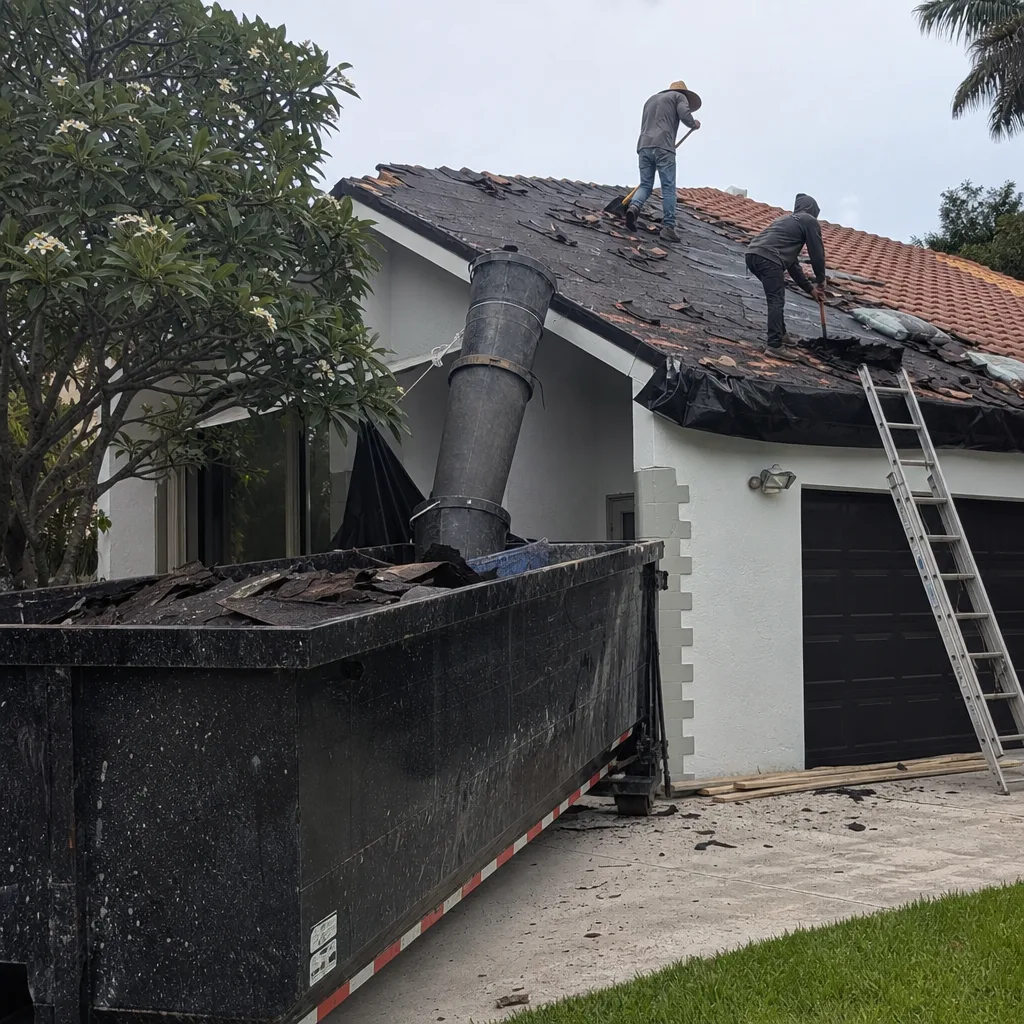
Drive through Coral Gables and you’ll see two versions of the same tile roof – one still rust-red after 40 years, one chalky white with algae stains that won’t come out. The difference is usually clay versus concrete, and Miami’s humidity is the reason it matters.
Why Miami Treats These Two Tiles So Differently
Subtropical air here is wet almost year-round, the rain averages over 60 inches annually, and the coastal salt comes in on the same breeze. That combination exposes a performance gap that a dry-climate buyer never feels.
Concrete tiles are porous. A typical concrete tile takes on 13-15% of its own weight in water during a soak; clay takes on 6% or less. On a single small patch that sounds like trivia. Scaled across thousands of tiles on a MiMo flat-slope or a Coral Gables gable, that absorbed water becomes real structural load, it dead-feeds algae and mildew growth, and it stresses the underlayment from the back side. Clay’s density resists absorption, which is why the old barrel roofs in Coral Gables still look like old barrel roofs instead of chalky concrete.
That doesn’t make concrete a bad material – it’s cheaper, available in profiles that pass Miami-Dade approval, and performs well when it’s specified correctly. It just means the maintenance math between the two isn’t close in our climate, and most comparison pages never put a number on it.
What to Actually Look For (a Miami Checklist)
Before you compare price per square, compare the things that fail under our specific conditions. This is what we check on every tile roof we quote:
- Absorption rate. Ask your installer for the manufacturer’s absorption spec. Under 6% is where clay lives; 13-15% is where most concrete lands. In this climate, that gap costs you on load and on cleaning.
- The Miami-Dade NOA. Miami-Dade County is the only place in the US with its own product-approval system, and every roof must carry a Miami-Dade Notice of Acceptance (NOA) number – not just a Florida or national approval. Not every tile profile from either material is approved for the High Velocity Hurricane Zone. Verify the specific profile and manufacturer, not just “clay” or “concrete” as a category.
- Underlayment spec. The tile is the pretty part; the underlayment is what actually keeps the house dry. Concrete’s higher absorption can degrade the deck and underlayment faster, so a concrete install usually needs a different (and often higher-spec) underlayment than a clay install. Make sure your quote shows the spec – not just a lump sum.
- Architectural and covenant fit. On a 1920s Mediterranean Revival home in Coral Gables, a MiMo building, or a historic district, swapping clay barrel for a concrete profile can trigger permitting review and neighborhood covenant questions. Match the material to what the house and the district expect.
- The 40-Year Recertification. Miami-Dade requires buildings at 40 years (25 near the coast) to be inspected for structural and electrical safety. That inspection looks at the substrate and underlayment, not just the tile – which is exactly where concrete’s moisture behavior shows up first. A degraded deck can mean a failed recertification and expensive remediation.
Clay vs Concrete, Side by Side
Here’s the comparison we put in front of Miami homeowners, with the numbers our own quotes turn on:
| Factor | Clay tile | Concrete tile |
|---|---|---|
| Water absorption | 6% or less | 13-15% |
| Algae / biological growth in Miami humidity | Slow; density resists | Fast; needs routine cleaning |
| Added wet load on structure | Low | Higher – matters on older CBS decks |
| Underlayment spec | Standard high-spec underlayment | Often higher-spec to offset moisture |
| Architectural match (Coral Gables / MiMo / historic) | Authentic barrel profile | Profile-dependent; may need review |
| Up-front cost | Higher | Lower |
| Miami-Dade NOA requirement | Required per profile | Required per profile |
If you want tiles that look the same in 30 years with minimal fuss and you own the kind of house that was built for them, clay wins. If you’re watching the number and can commit to maintenance, concrete is a legitimate choice. Either way, the underlayment and NOA matter more than the material label – which is why we price them honestly up front rather than burying it.
What Tile Work Costs in Miami
Upfront pricing, no surprises is the whole point of putting this on the page. Concrete is generally the cheaper tile, clay runs higher, and the underlayment spec change that comes with concrete is a real line item you should see before signing:
- Roof replacement: $9,440-$23,600
- Roof repair: $470-$2,125
- Tile roof repair: $710-$2,950
- Metal roof installation: $17,700-$47,200
Those ranges reflect Miami’s market and don’t change because you picked one material over the other in this article – the number is the number. Every project we do is backed by our 730-Day Done Right Promise, and our material partners include NOA-verified tile systems so what goes on your roof actually passes Miami-Dade review. Our technicians have up to 12 years of experience, they’re background-checked and in uniform on every job, and calls are answered by a live person 24/7. If you’d like the full picture on how we handle roofing beyond tile, our Roofing page covers the rest.
Financing makes the up-front gap easier to swallow: 0% for 18 months, and $1,000 off projects over $10,000. When you’re comparing clay’s higher tag to concrete’s lower one, that’s how you close the difference without cutting the spec. For a free estimate and design consult, call (833) 968-1198.
FAQ
For most Miami homes, clay is the better long-term performer and concrete is the better budget choice. Clay absorbs 6% or less of its weight in water versus 13-15% for concrete, so it resists algae, adds less wet load, and holds up to our humidity and salt air with less routine cleaning. Concrete is legitimate but needs a correct underlayment spec and more maintenance in this climate. Call (833) 968-1198 for a free assessment – estimates are free.
Yes – every roof in Miami-Dade County must carry a Miami-Dade Notice of Acceptance (NOA) number for the specific profile and manufacturer, not just a national or Florida approval. Not every clay or concrete profile is approved for the High Velocity Hurricane Zone, so verify the exact product, not the material category. Our material partners include NOA-verified tile systems, and our free estimate walks the approval with you – call (833) 968-1198.
Concrete tiles themselves don’t fail recertification, but their higher water absorption can degrade the deck and underlayment faster, and that’s exactly what the 40-Year inspection evaluates. On a 40-year-old Miami building (25 near the coast), a weakened substrate can mean remediation you didn’t plan for. It’s one more reason the underlayment spec in your quote matters. Call (833) 968-1198 for an honest look before you sign anything.
You can, but on a historic or MiMo home it’s worth checking the permitting and covenant requirements first, because swapping the original clay barrel profile for concrete can affect review. Concrete is often an acceptable match where the profile lines up and the district allows it; clay stays the authentic choice. Call (833) 968-1198 and we’ll review your address, your neighborhood rules, and the profile together – no pressure.
Let’s Look at Your Roof
If you’d rather have it looked at than guess, Groundwork Construction Co. of Miami offers a no-pressure assessment in Miami – free estimate and design consult, upfront pricing, 0% financing for 18 months and $1,000 off projects over $10,000. Call (833) 968-1198 and a live person answers, any hour. You can also see everything we handle on our home page and across our Miami service area.
Written by the team at Groundwork Construction Co. of Miami, serving Miami, FL.