
 Kitchen remodeling
 Bathroom remodeling
 Home additions & ADU
 Roofing
 Windows & doors
 Driveway & pavers
 Fence
Free written scope consultation - allowances, timeline, and change-order rules on paper before a single trade is scheduled
Styles & brands we work with
- Kitchen remodeling
- Bathroom remodeling
- Home additions & ADU
- Roofing
- Windows & doors
- Driveway & pavers
- Fence
See the difference
 Before
 After
 Before
 After
 Before
 After
How Long Does a Tile Roof Last in Miami? The Tile and the Underlayment Are Two Different Answers
A quality clay tile roof lasts 50 to 100 years, and concrete tile runs 30 to 50 years. But that’s only half the story in Miami. The waterproofing layer beneath those tiles - the underlayment - typically gives out in 15 to 20 years under our sun, humidity, and salt air. That gap is the whole problem. Most Miami homeowners will need a full re-roofing project decades before a single tile fails. If your roof is past the 15-year mark, call Groundwork Construction Co. of Miami at (833) 968-1198 for a straight assessment of both layers.
Key takeaways
- Tile lifespan and underlayment lifespan are two separate numbers, and the underlayment fails first.
- In Miami’s UV and humidity, plan on the low end of the underlayment range, not the high end.
- Passing the 40-Year Recertification almost always means replacing the underlayment, no matter how the tiles look.
- Florida Building Code’s 25% rule can turn a small patch into a full code-compliant re-roof, so proactive replacement is often the cheaper path.
Your tiles look fine. The shield under them doesn’t.
Walk down any street in Coral Gables or Pinecrest and you’ll see tile roofs that look basically new. The tiles probably are fine. Clay and concrete are tough, and they shrug off sun and rain for decades. What’s failing is the layer you can’t see: the felt, SBS-modified, or peel-and-stick waterproofing sheet under the tile. It’s doing all the real work of keeping water out of your house.
Miami eats that shield fast. Our year-round humidity, intense UV, and salt-laden coastal air break down underlayment well before it reaches the upper end of its rated life. Standard felt might be rated 15 to 25 years, and SBS-modified or peel-and-stick cap sheet 25 to 35, but in Miami, treat the lower end as your realistic baseline. A roof installed in 2008 with felt under it is probably already living on borrowed time, even if the tile on top looks untouched.
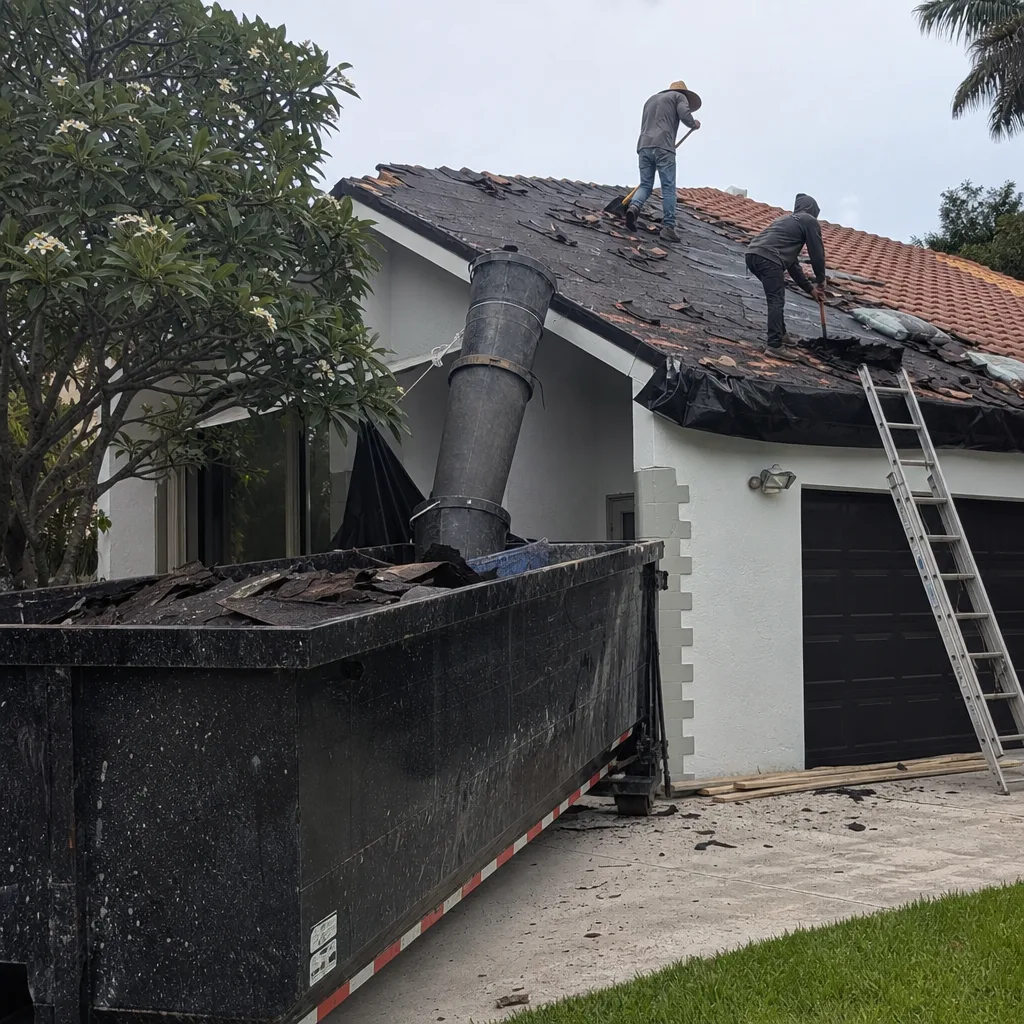
Here’s where the cost distinction matters. Replacing tiles is one line item. Replacing the underlayment means lifting every tile, inspecting and often repairing the deck, laying new waterproofing, and setting the tile back down. That’s a full roofing project, and it’s why a tile roof that “still looks good” can still need a five-figure job.
Why Miami tile roofs age differently than the tile alone suggests
Miami-Dade County sits inside the High Velocity Hurricane Zone, and it’s the only place in the country with its own product-approval system. Every roof system here has to carry a Miami-Dade NOA number, not just a Florida or national stamp. That matters when you re-roof, because the new underlayment and attachment have to be a current approved assembly. When your old system was installed, the rules were different. Bringing it up to today’s standard is part of the job.
Coastal properties in VE and AE flood zones add another wrinkle. Salt mist works its way in at the eave edge, where the underlayment is most exposed, and breaks it down faster than anywhere else on the roof. That’s a detail most estimates skip. On every coastal re-roof we specify extra eave protection, because that’s exactly where these roofs leak first.
Older housing stock raises the stakes again. Much of Miami’s pre-1970s concrete-block and CBS housing, plus the 1920s Mediterranean Revival buildings, was built with roof structures and attachments that predate modern wind codes. When a re-roof uncovers soft deck boards or failed fasteners, the fix is structural, not cosmetic. We show you what we find before we touch it, so nobody gets surprised mid-project.
The 40-Year Recertification: your real deadline in Miami
Miami-Dade requires buildings at 40 years (25 years near the coast) to pass a structural and electrical safety inspection known as the 40-Year Recertification. If your building is heading for that milestone with an original underlayment from the 1980s, plan on a full re-roof to pass. The inspector isn’t grading your tile’s appearance. The roof has to be sound and documented.
This is where homeowners get caught. They see good-looking tile, assume the roof is fine, and then a recertification inspection flags a failing underlayment they never knew was going. If you’re within a few years of your inspection date, start planning now. Budgeting and scheduling a re-roof on your timeline beats scrambling to fix it on the city’s.
The Florida Building Code 25% rule, explained
Florida’s re-roofing trigger rule matters for anyone thinking about patching. When more than 25% of a tile roof is repaired or replaced, the entire roof has to be brought up to current code. In the HVHZ, that means a current NOA-compliant system across the whole roof, not just the patched section.
Run the math on a typical Miami tile repair, which lands in the $710 to $2,950 range for a small area. If the damage is spread across zones, or the underlying felt is shot, patching piece by piece can cost more than one planned replacement, and it leaves you with a mixed-code roof. Proactive replacement is often the smarter spend. A full roof replacement in Miami runs $9,440 to $23,600 depending on size, pitch, and deck condition, and you get one code-compliant system instead of a patchwork.
What a tile re-roof actually costs in Miami
| Line item | Typical Miami range |
|---|---|
| Tile roof repair (small area) | $710 - $2,950 |
| Roof repair (general) | $470 - $2,125 |
| Full roof replacement (all-in) | $9,440 - $23,600 |
| Metal roof installation (for comparison) | $17,700 - $47,200 |
Those ranges cover the whole system: tile, underlayment, deck inspection, and the structural findings that turn up along the way. That’s the difference with Groundwork’s upfront pricing. The number you see is the number you pay, and it accounts for the deck boards and the code upgrades up front, not after the crew has your roof torn open. New systems like GAF and CertainTeed products, plus 0% financing for 18 months and $1,000 off projects over $10,000, make a full re-roof easier to plan around.
Everything is backed by our 730-Day Done Right Promise. If it’s not done right, we make it right. That’s one of the longest workmanship guarantees in residential construction, and it’s why we’d rather show you the full picture now than hand you a per-square tile price that ignores the underlayment.
Common local scenarios we see
A 1990s Coral Gables home nearing recertification. The tile is original and still solid-looking, but the felt under it is 30-plus years old. The recertification inspection flags moisture at the deck. This is a full re-roof, planned to a deadline, not an emergency.
A coastal Key Biscayne property in a VE zone. Salt mist has eaten the underlayment at the eave edge, and leaks show up at the perimeter long before the field tiles fail. Extra eave protection on the re-roof is the fix.
A Pinecrest home with scattered leaks after a heavy storm season. Three separate repair calls in two years, each in a different spot. The underlayment is failing broadly, and the 25% rule is about to force a full code upgrade anyway. One planned replacement ends the cycle.
Some tile roofs really are near the end of their tile life and need a straightforward replacement, and some are simple repairs. Knowing which one you’re looking at is the whole point of an assessment. Our technicians have up to 12 years of experience reading exactly this kind of roof, and we’ll tell you which bucket yours falls into. If you want the full picture on our roofing work, start with our Roofing service page.
FAQs
The tile itself lasts 50 to 100 years for quality clay and 30 to 50 for concrete, but the underlayment under it usually fails in 15 to 20 years in Miami’s climate, so plan on a re-roof around that mark. Call (833) 968-1198 for a free estimate that covers both layers.
If the underlayment is still sound, repair is cheaper, but once more than 25% of the roof needs work, Florida Building Code requires the whole roof to meet current code, so replacement usually wins out. A tile repair runs $710 to $2,950, while a full replacement runs $9,440 to $23,600. Call (833) 968-1198 for a straight comparison on your roof.
Yes, if your building is at 40 years (25 years near the coast), Miami-Dade requires a structural and electrical safety inspection, and a failing underlayment will keep you from passing. Call (833) 968-1198 and we’ll assess your roof against that deadline.
Because the water is getting past the underlayment, not the tile. The tiles are the armor; the waterproofing layer beneath them is the shield, and in Miami’s sun and salt air that shield degrades first. Call (833) 968-1198 to find out where yours is failing.
Get a straight answer on your tile roof
If you’d rather have it looked at, Groundwork Construction Co. of Miami offers a no-pressure assessment in Miami. We answer the phone with a live person 24/7, show up in uniform, and give you upfront pricing on the full system, not just the tile. Call (833) 968-1198 for a free estimate and design consult. You can also see the full breadth of what we do across our Miami service area and the rest of the home page.
Written by the team at Groundwork Construction Co. of Miami, serving Miami, FL.