
 Windows & doors
 Kitchen remodeling
 Bathroom remodeling
 Home additions & ADU
 Roofing
 Driveway & pavers
 Fence
Free written scope consultation - allowances, timeline, and change-order rules on paper before a single trade is scheduled
Styles & brands we work with
- Kitchen remodeling
- Bathroom remodeling
- Home additions & ADU
- Roofing
- Windows & doors
- Driveway & pavers
- Fence
See the difference
 Before
 After
 Before
 After
 Before
 After
Do New Windows Save Energy in Miami? Yes, But Not the Way You Think
Yes. New windows absolutely save energy in Miami, but not because of insulation value. In our subtropical climate, the savings come from blocking solar heat gain, not from keeping heat inside. Put simply: a window with a Solar Heat Gain Coefficient (SHGC) of 0.25 versus one at 0.40 can mean $600 to $900 a year in AC costs for a typical Miami home. The gold standard in cold climates, triple-pane, does little here. What matters is the glass’s ability to reject radiant heat from that intense year-round sun. If you’d like to know exactly what your windows are costing you, call (833) 968-1198 and we’ll talk it through, no pressure.
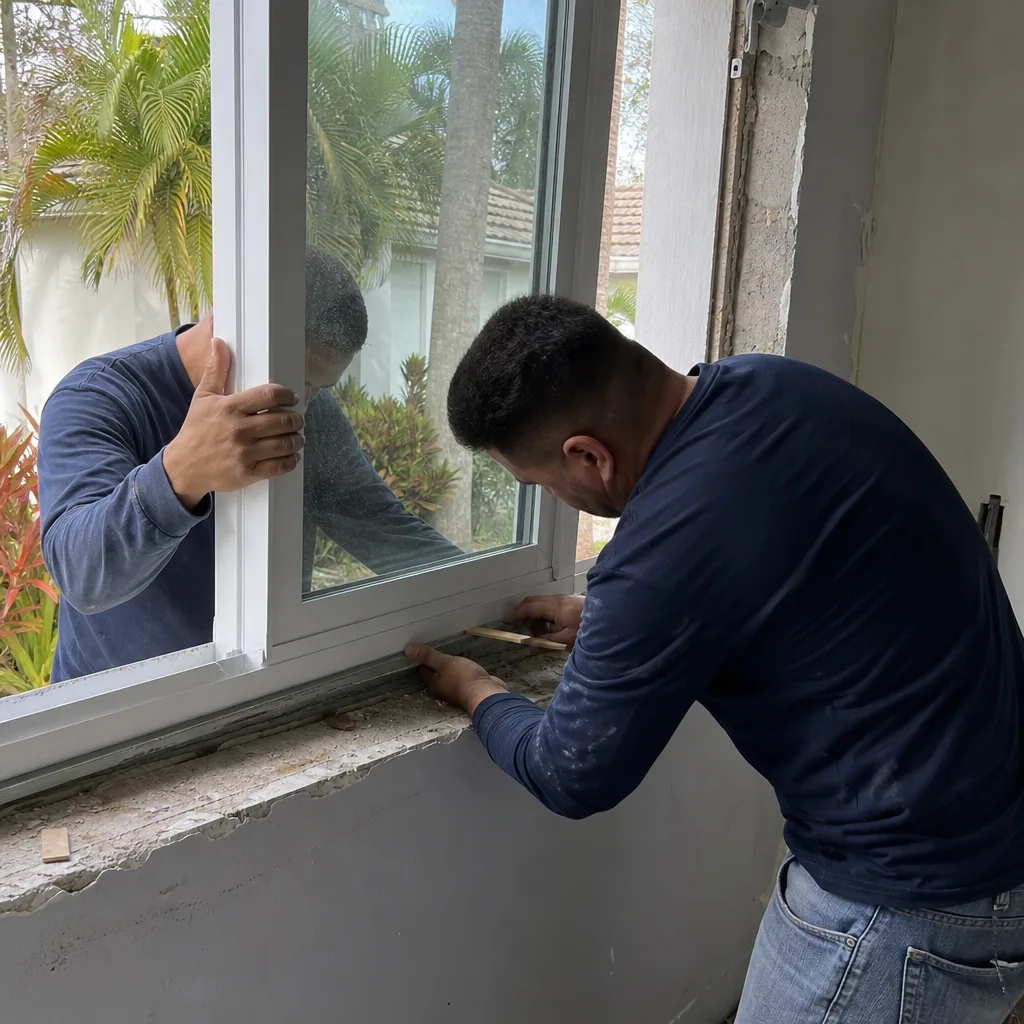
Why the Standard “Energy-Saving Windows” Advice Fails in Miami
Most window guides you’ll find online were written for homeowners in Minnesota, Michigan, or upstate New York. They’re obsessed with U-factor, which measures how well a window resists heat flow. In a cold climate, that’s the whole game: you don’t want heat leaking out through the glass. In Miami, the game is inverted. Our cooling season never really ends, and the sun hits us at a punishing angle for most of the year. The heat you want to stop isn’t leaving through the window, it’s pouring in.
That’s why a Miami-Dade permit reviewer cares far more about your SHGC and your Miami-Dade NOA number than your U-factor. Miami-Dade County is the only place in the country with its own product-approval system, and every window in a new or replacement opening must carry an NOA. The good news: impact laminated glass approved under that system, paired with a low-E coating, inherently reduces solar heat gain compared to uncoated glass. So impact compliance and energy performance ride on the same piece of glass rather than fighting each other.
We’ve replaced enough windows across Miami neighborhoods to know that exposure matters as much as ratings. A west-facing wall in Little Havana takes the afternoon sun head-on and runs hotter than a shaded north-facing wall in Pinecrest. That’s why an honest window conversation starts with which rooms are unbearable in July, not with a ratings chart.
What to look at on the label
- SHGC: lower is better in Miami. Aim under 0.25 wherever the budget allows. This is the number doing the real work.
- Visible transmittance (VT): the daylight trade-off. A very low SHGC glass can darken a room, so we balance the two; a low SHGC with decent VT keeps the room bright without baking it.
- Warm-edge spacer: the hidden performance detail. A quality warm-edge spacer cuts humid air infiltration, which reduces the dehumidification load on your AC, the invisible energy saving only a subtropical climate cares about.
- U-factor: still worth checking, but treat it as a tiebreaker, not the headline.
What Can a Miami Homeowner Realistically Save?
Replacing single-pane or older standard double-pane windows with low-SHGC impact windows in a 2,000 sq ft CBS home can cut cooling load by 15% to 25%. That translates to roughly $500 to $1,200 a year in AC savings, with wide variance based on exposure orientation and how well the existing attic is insulated. West and south-facing walls see the biggest gains; a shaded interior wall sees less.
Here’s how window work typically pencils out in Miami, so you can weigh the spend against the savings:
| Project | Typical Miami range |
|---|---|
| Impact window installation | $9,440 – $29,500 |
| Standard window replacement | $5,310 – $17,700 |
The difference between standard and impact windows is the difference between a weather-event problem and a solved one: impact glass doubles as energy savings and hurricane protection, so the cost isn’t only about AC. If you want to see how that trade-off looks for your home, our Windows & Doors team can walk through it.
How Do Impact Requirements and Energy Performance Line Up?
This is the part most homeowners miss. Impact compliance and energy performance don’t compete in Miami: they’re delivered in the same product. The low-E coatings applied to NOA-approved impact laminated glass inherently reduce SHGC compared to uncoated glass. So when you purchase a window that meets the High Velocity Hurricane Zone code, you’re also buying a window with a better solar heat gain coefficient than a plain-glass alternative. One product, two jobs served.
Andersson and Marvin both publish verified SHGC ratings by product line, which means you can see the exact performance spec before you buy, rather than reading a vague efficiency claim on a brochure. We work with those manufacturers because the transparency matters when you’re making a decision this size. For homeowners who want a reliable, verifiable spec sheet, that’s a real advantage. It’s one reason our customers in neighborhoods like Coconut Grove and Kendall often settle on a specific glass before we’ve even measured their openings.
Where Does Groundwork Construction Co. of Miami Fit In?
We’re a full-scope construction partner, and windows sit alongside kitchens, baths, roofing, and additions under the same roof. That matters for energy work because windows and insulation, ventilation, and roofline interact; a home that saves the most from glass is one where the whole envelope is considered together. Our technicians have up to 12 years of experience, arrive background-checked and in uniform, and are covered by our 730-Day Done Right Promise: if it’s not done right, we make it right. Pricing is upfront, so the number we quote is the number you pay, and 0% financing for 18 months (with $1,000 off projects over $10,000) is available to make a full-house window replacement workable in a single year.
Before any window gets ordered, we look at your home’s actual exposure, your current attic insulation, and how your AC is handling the load. We’d rather find the real culprit first. When a window isn’t the answer, we’ll tell you. You can explore the full scope of what we do on our home page and see how we serve the broader area on our Miami service area page.
FAQs
Yes, mainly through solar heat gain reduction rather than insulation value, because Miami’s cooling season runs year-round. Replacing single-pane glass with low-SHGC impact windows on a 2,000 sq ft CBS home typically cuts cooling load by 15% to 25%, or roughly $500 to $1,200 annually depending on exposure. Call (833) 968-1198 for a free estimate tailored to your home.
Aim for an SHGC under 0.25 wherever the budget allows, since that’s the number that keeps the subtropical sun out. The difference between 0.25 and 0.40 can mean $600 to $900 a year in AC costs for a typical Miami home, so it’s worth prioritizing over U-factor. A consultation can help you balance SHGC against visible light; estimates are free.
Usually not, because the extra insulation value of a third pane is optimized for cold climates and does little in Miami’s warmth. Your budget is better spent on a low-SHGC impact glass with a warm-edge spacer and verified ratings. Call (833) 968-1198 and we’ll help you put the money where it actually cools the house.
Yes; the low-E coating on NOA-approved impact laminated glass reduces solar heat gain at the same time it meets High Velocity Hurricane Zone requirements, so you’re not choosing one over the other. That dual benefit is a big part of why impact glass pencils out financially for Miami homeowners. Get a free estimate and see the numbers for your openings.
If you’d rather have it looked at, Groundwork Construction Co. of Miami offers a no-pressure assessment in Miami - call (833) 968-1198. We’ll measure, check your ceiling insulation and exposure, and tell you honestly whether new glass will pay you back.
Written by the team at Groundwork Construction Co. of Miami, serving Miami, FL.