
 Windows & doors
 Kitchen remodeling
 Bathroom remodeling
 Home additions & ADU
 Roofing
 Driveway & pavers
 Fence
Free written scope consultation - allowances, timeline, and change-order rules on paper before a single trade is scheduled
Styles & brands we work with
- Kitchen remodeling
- Bathroom remodeling
- Home additions & ADU
- Roofing
- Windows & doors
- Driveway & pavers
- Fence
See the difference
 Before
 After
 Before
 After
 Before
 After
Vinyl vs. Fiberglass Windows in Miami: Which Material Survives the HVHZ?
Choose fiberglass unless budget is the hard ceiling – and even then, ask what the vinyl warranty excludes in a coastal high-UV zone before you sign. In Miami’s High Velocity Hurricane Zone, fiberglass frames hold dimensional stability, finish, and NOA-approved performance far longer than vinyl, and over a 15-year horizon they’re almost always the smarter buy. Vinyl wins the price comparison almost everywhere. In Miami, it loses the climate comparison. Call (833) 968-1198 for a straight read on your specific facade and window count.
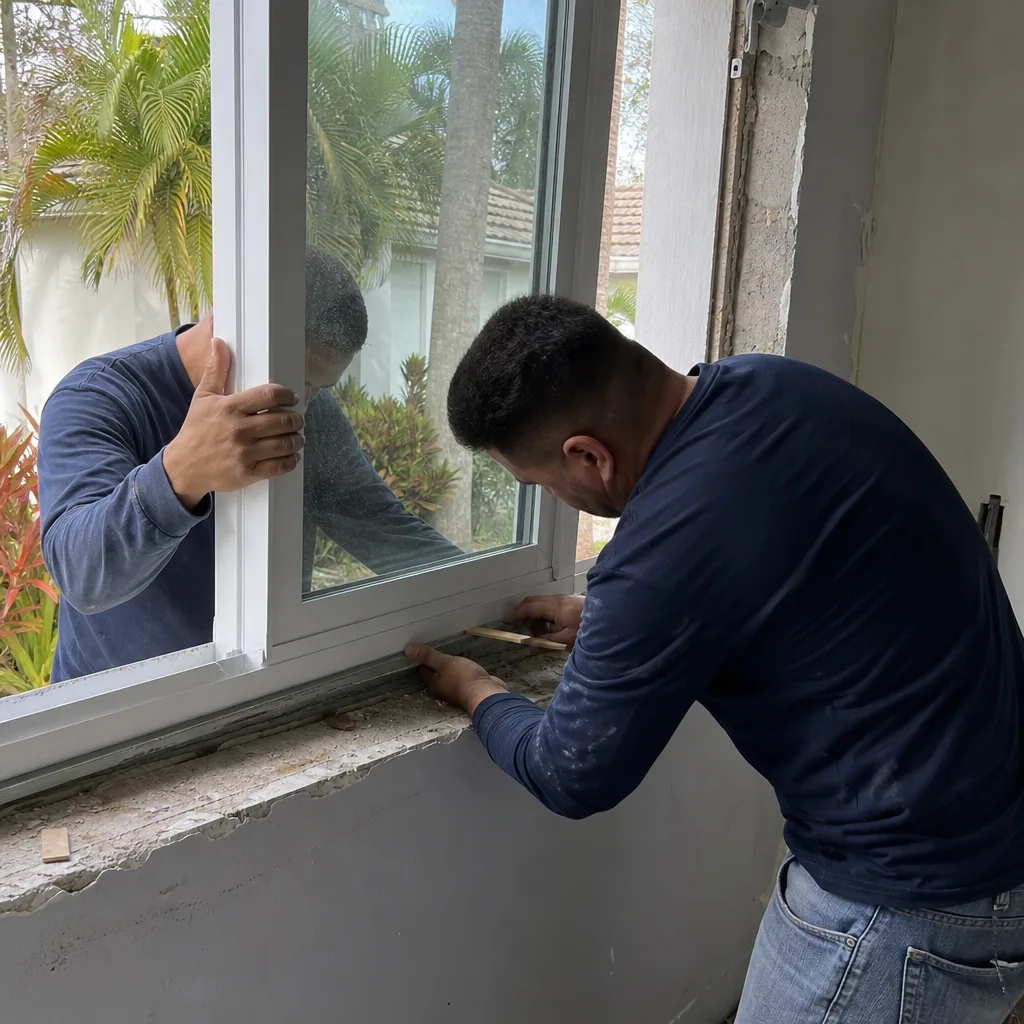
Key Takeaways
- Vinyl PVC oxidizes faster under Miami’s subtropical sun, causing chalking and brittleness in 10-15 years.
- Vinyl expands and contracts roughly 3x more than fiberglass with temperature swings, stressing glazing seals.
- Miami-Dade’s own NOA approval system means every window needs a valid NOA number – not just a Florida or national rating.
- Fiberglass keeps its surface finish and paint adhesion better in salt-laden coastal air.
- Groundwork backs the choice with a 730-Day Done Right Promise.
Why Vinyl Degrades Faster in Miami Than Anywhere Else
PVC window frames in Miami face a stress cycle no temperate market replicates. Year-round humidity, intense direct sun on west-facing facades, and salt-laden coastal air combine into accelerated UV oxidation. What that looks like on a real frame over time: chalking on the surface, color fade, then brittleness at the corners where the frame meets glass. The glazing seal is the first thing to go.
Here’s the detail most comparison pages skip. Vinyl manufacturers know this failure mode exists in South Florida, and many warranties carve out coastal and high-UV environments in the fine print. A homeowner buys a “lifetime” warranty and later learns the coverage doesn’t apply in a Miami-Dade coastal zone. We’ve seen that movie. It’s why we read the warranty exclusions out loud with clients before anyone orders a frame.
The Thermal Expansion Math That Breaks Vinyl Seals
Vinyl expands and contracts at roughly three times the rate of fiberglass when temperature changes. In a mild climate, that’s a manageable difference. In Miami, daily temperature swings plus intense sun on a west-facing wall hammer the frame with stress cycles. Each cycle nudges the frame-to-glass seal and the anchor connections. Over a decade, those cycles loosen both.
Fiberglass moves far less. Its dimensional stability means the seal sits tighter and the anchors stay put longer. That’s why, at equivalent performance ratings for Miami-Dade NOA approval, you’ll find more compliant fiberglass window lines than vinyl options. The structural demands of HVHZ cyclic pressure testing expose the gap that a temperate-climate comparison completely hides.
Side-by-Side: Vinyl vs. Fiberglass in a Miami Coastal Zone
| Factor | Vinyl | Fiberglass |
|---|---|---|
| Upfront cost | Lower – often 15-25% less | Higher |
| Thermal expansion vs. fiberglass | ~3x the movement | Baseline |
| UV oxidation (subtropical sun) | Chalking, brittleness in 10-15 yrs | Minimal surface change |
| Coastal salt-air finish | Fades and chalks faster | Holds finish, better paint adhesion |
| NOA-approved lines at equivalent rating | Fewer | More |
| Warranty gaps in coastal/high-UV zones | Commonly excluded | Less exposed |
| Best for | Interior-facing or shaded openings, tight budgets | Exposed coastal facades, long-horizon value |
Neither material corrodes the way aluminum can in salt air. That’s a real point in both columns. But fiberglass’s higher density and paint adhesion mean it keeps a cleaner surface finish through Miami’s coastal environment, which cuts the maintenance cycle and the repainting you’d otherwise budget for.
What Groundwork Specifies – and What the Guarantee Covers
We specify Andersen and Marvin window lines, both of which offer fiberglass product families with active Miami-Dade NOA approvals. That matters here because Miami-Dade County is the only place in the US with its own product-approval system. Every window must carry a Miami-Dade NOA number, not just a Florida or national approval. A frame can be beautiful and rated for a hurricane and still fail the county’s paperwork. We check the NOA before the order goes in. Our Windows & Doors team handles the approval trail and the install as one job.
Then the accountability part. The 730-Day Done Right Promise means if a frame material choice underperforms in Miami’s climate within two years of installation, we make it right – not the homeowner. One of the longest workmanship guarantees in residential construction, and it covers the material decision, not just the caulk line. From foundation to finish line, built to last and backed in writing.
Pricing, so you can plan. Typical Miami metro ranges we quote:
- Window replacement: $5,310-$17,700
- Impact window installation: $9,440-$29,500
- Small bathroom remodel (for scope reference on interior trim work): $5,900-$14,160
- Bathroom remodel with Schluter waterproofing detail: $10,620-$33,040
Upfront pricing, no surprises – the number you see is the number you pay. No-hassle financing at 0% for 18 months and $1,000 off projects over $10,000 make the fiberglass step-over easier to absorb. Live person, 24/7, when a window question hits you at an odd hour. Learn more about the wider home renovation work we take on, or see our full Miami service area.
The Counterintuitive Part: When Vinyl Is Still the Answer
We won’t pretend fiberglass wins every job. If your openings face a shaded courtyard, sit under a deep overhang, or live on the interior side of a CBS block wall with limited direct sun, vinyl’s UV exposure drops and its price advantage gets real. For a flip on a tight schedule or a rental where the next owner carries the long-term risk, vinyl can pencil out.
The honest rule: fiberglass for exposed coastal facades and west-facing walls you plan to keep; vinyl for shaded, budget-driven, or shorter-horizon installs. We’ll tell you which one your house is, and if that answer costs us the bigger sale, so be it. Our technicians have up to 12 years of experience reading Miami facades – the sun exposure, the elevation, the storm path – and that’s the read that decides it.
FAQs
Yes, for most exposed Miami openings, fiberglass is the better long-term choice because it resists UV oxidation, salt-air finish wear, and the thermal-cycling stress that breaks vinyl seals in a subtropical, coastal zone. Vinyl still makes sense for shaded or budget-tight jobs. Call (833) 968-1198 for an exact quote – estimates are free.
Fiberglass typically runs 15-25% more than vinyl on the same opening, and full window replacement in Miami runs $5,310-$17,700 with impact window installation at $9,440-$29,500. Exact numbers depend on window count, elevation, and NOA-required specs. Call (833) 968-1198 for a free, no-surprise estimate.
Because vinyl PVC degrades faster under intense UV and salt air, so manufacturers commonly carve those environments out of coverage, which in Miami is exactly where the failure happens. A warranty that doesn’t apply here isn’t much of a warranty. Call (833) 968-1198 and we’ll read the exclusions with you before you order.
Yes. Miami-Dade is the only US county with its own product-approval system, so every window in the High Velocity Hurricane Zone must carry a valid NOA number, not just a national or state rating. Groundwork checks the NOA on every line we specify. Call (833) 968-1198 to confirm your spec.
Ready to Settle the Vinyl vs. Fiberglass Question?
Fiberglass for exposed coastal facades, vinyl for shaded budget jobs – and the right call depends on your specific wall, elevation, and NOA requirements. If you’d rather have it looked at, Groundwork Construction Co. of Miami offers a no-pressure assessment in Miami – call (833) 968-1198.
Written by the team at Groundwork Construction Co. of Miami, serving Miami, FL.