
 Fence
 Kitchen remodeling
 Bathroom remodeling
 Home additions & ADU
 Roofing
 Windows & doors
 Driveway & pavers
Free written scope consultation - allowances, timeline, and change-order rules on paper before a single trade is scheduled
Styles & brands we work with
- Kitchen remodeling
- Bathroom remodeling
- Home additions & ADU
- Roofing
- Windows & doors
- Driveway & pavers
- Fence
See the difference
 Before
 After
 Before
 After
 Before
 After
Aluminum vs Wrought Iron Fence in Miami: Choose Aluminum Unless Historic Authenticity Is the Whole Point
For most Miami homeowners, aluminum is the better fence. It costs $4,720-$11,800 installed, never needs repainting, and shrugs off salt air. Wrought iron wins only in one situation: a pre-1970s Mediterranean Revival or MiMo property in a historic district where the original material has to match, and the owner accepts a real maintenance cycle. That’s the honest split. The rest of this page is the reasoning behind it, grounded in what actually happens to both materials on Miami lots over ten years. Call (833) 968-1198 for a free estimate and we’ll tell you which side of that line your property falls on.
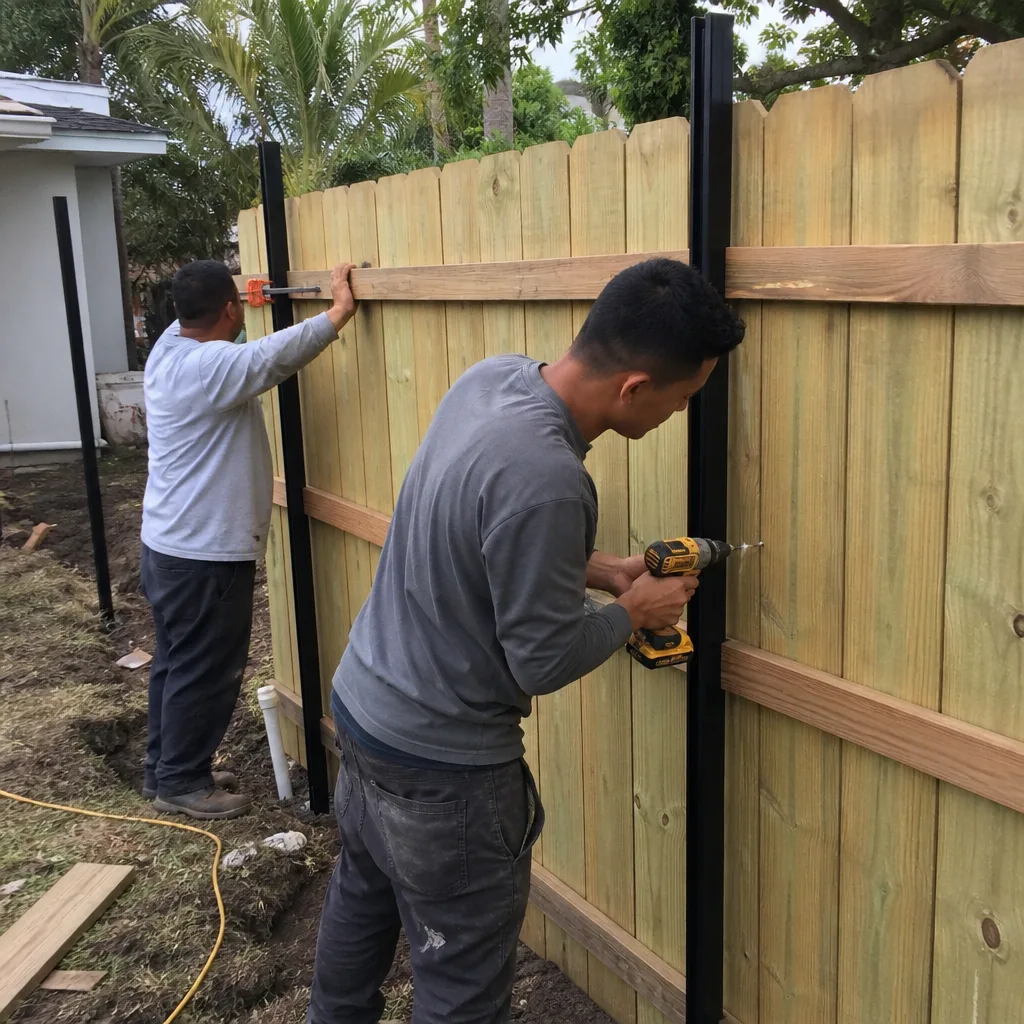
Key takeaways
- Within 1-2 miles of the coast, raw wrought iron can show rust bloom in 12-18 months without an annual touch-up coat.
- A full sandblast and repaint on a 150-linear-foot ornamental iron fence in Miami runs $800-$2,000 every 3-5 years.
- Aluminum oxidizes into a protective layer that stops further corrosion. Wrought iron rusts through from the surface.
- Historic districts may require a Certificate of Appropriateness before aluminum replaces iron.
- Both meet Miami-Dade NOA wind-load rules, but aluminum hits deflection limits with lighter posts.
That wrought iron fence on the Coral Gables Mediterranean Revival looks beautiful in the listing photos. It also needed sandblasting and repainting twice in the last five years. Miami’s salt air doesn’t care about aesthetics. Here’s the maintenance math most buyers never see before they sign.
The corrosion story that decides this for you
The two metals fail in opposite directions, and that’s the whole comparison in one sentence. Wrought iron rusts from the surface inward. Every chip, every scratch, every spot the sun bakes a little harder becomes a place where moisture gets under the paint and starts eating the metal. It doesn’t stop on its own. Aluminum oxidizes too, but the aluminum oxide layer that forms on the surface actually seals the metal underneath and halts further corrosion. In Miami’s salt-spray environment that’s not a small footnote. It’s the difference between an annual chore and a one-time install.
Out on the islands and along the coastal blocks of Miami Shores, we see the wrought iron cycle hit fast. A homeowner paints in year one, touches up in year two, and by year four the bottom rails are pitted enough that a wire brush won’t save them. Salt accelerates all of it. Inland, away from the spray line, wrought iron ages more gracefully, but the annual touch-up still doesn’t go away. Aluminum just sits there.
Here’s how the ten-year cost picture breaks down on a typical ornamental run:
| Line item | Aluminum | Wrought iron |
|---|---|---|
| Installation | $4,720-$11,800 | Often higher per linear foot |
| Annual touch-up | $0 | Paint and spot repairs |
| Full sandblast + repaint (150 ft) | Never | $800-$2,000 every 3-5 years |
| First rust bloom near coast | None | 12-18 months without coating |
| 10-year maintenance total | $0 | $1,600-$4,000+ |
The repaint number is the one that surprises people. Two repaints over a decade puts wrought iron well past the aluminum ticket before you count a single hour of your own time brushing and priming.
Historic districts change the answer entirely
Coral Gables and Miami Shores both have preservation guidelines that matter here. On a contributing property, replacement fencing has to match the original material or be formally approved for visual equivalency. That means swapping iron for aluminum can require a Certificate of Appropriateness before the permit clears. It’s a step most fence companies don’t build into the timeline, and it’s one our permitting process handles from day one. We’d rather file the paperwork correctly than have an inspector red-tag a finished fence.
If you’re on a historic property and the authenticity is the point, wrought iron is genuinely the right material. We’ll say so. Pretending aluminum is a perfect stand-in for a 1920s iron gate is the kind of shortcut that costs homeowners later. For everything outside those districts, aluminum does the job without the drama. Our Fence Installation in Miami page covers how we scope a project from the first walk-through.
Wind load, post size, and the Miami-Dade NOA question
Miami-Dade is the only place in the country with its own product-approval system, so every fence component that matters structurally has to carry a Miami-Dade NOA number, not just a Florida or national stamp. Both aluminum and wrought iron can be engineered to meet those wind-load requirements. The difference shows up in how you get there. Aluminum’s lighter weight and welded post-panel connections make it easier to hit deflection limits without upsizing posts. On older CBS lots packed with established landscaping near the fence line, that smaller footprint matters. You’re not tearing out a mature hedge to fit a beefier iron post.
We spec panels from partners like Bufftech and ActiveYards when the aluminum route makes sense, and we walk the NOA documentation with you so there’s no mystery at inspection. Upfront pricing covers the engineering and the paperwork. The number you see is the number you pay.
Common local scenarios we run into
The Coral Gables restoration. A 1926 Mediterranean Revival with original iron, half of it rusting at the base plates. We restore the sections worth restoring and talk honestly about where replacement beats repair. Preservation approval gets filed before fabrication starts.
The Miami Shores pool fence. A family needs code-compliant pool barrier that survives salt air. Aluminum, every time. No repainting, no rust streaks dripping onto the deck, and it clears the code height and self-latching gate requirements without fuss.
The Brickell-adjacent townhome lot. Small yard, tight property line, mature palms already established. Aluminum’s lighter posts mean we don’t disturb the root zone to meet wind-load deflection limits.
The inland wrought iron holdout. A homeowner two miles from the coast who loves the look and doesn’t mind the touch-up. Fair enough. We quote it with the maintenance cycle spelled out so there are no surprises in year three.
Every project we take on carries the 730-Day Done Right Promise. If it’s not done right, we make it right, and that applies whether you picked aluminum or iron. Our technicians have up to 12 years of experience, and they show up background-checked and in uniform. Calls get answered by a live person, 24/7, so you’re never stuck in a voicemail black hole waiting on a callback. And with $1,000 off projects over $10,000 plus 0% financing for 18 months, the bigger ornamental runs stop being a budget cliff. Read more about the full scope of what we build on our home page.
FAQs
Aluminum fence installation in Miami runs $4,720-$11,800, and that’s the full installed cost. Wrought iron often prices higher per linear foot up front, and then adds $800-$2,000 for a sandblast and repaint every 3-5 years on a 150-foot run. Over ten years, the maintenance gap usually makes aluminum the cheaper total. Call (833) 968-1198 for an exact quote, estimates are free.
Within 1-2 miles of the coast, raw wrought iron can show rust bloom in 12-18 months without an annual touch-up coat. Salt spray is the culprit. Inland, the cycle slows, but the annual maintenance never fully disappears. Aluminum doesn’t incur that task at all because the oxide layer protects the metal. Call (833) 968-1198 and we’ll assess your exposure based on where your lot sits.
Possibly, but it usually requires a Certificate of Appropriateness first. Coral Gables and Miami Shores preservation guidelines call for replacement fencing to match the original material or be approved for visual equivalency on contributing properties. Skipping that step can stall a permit. We build the approval into our process from day one. Call (833) 968-1198 to talk through your property.
Yes. Both aluminum and wrought iron can be engineered to meet Miami-Dade NOA requirements, which is the county’s own product-approval system. Aluminum’s lighter weight and welded post-panel connections make it easier to satisfy deflection limits without enlarging the posts. That matters on older CBS lots with established plantings near the fence line. Call (833) 968-1198 for a no-pressure assessment and we’ll confirm what your lot needs.
Get a straight answer on your fence
If you’d rather have it looked at than guess, Groundwork Construction Co. of Miami offers a no-pressure assessment in Miami. We’ll tell you which material fits your property, your district, and your maintenance appetite, then put the price in writing. Call (833) 968-1198 for a free estimate.
Written by the team at Groundwork Construction Co. of Miami, serving Miami, FL.