
 Fence
 Kitchen remodeling
 Bathroom remodeling
 Home additions & ADU
 Roofing
 Windows & doors
 Driveway & pavers
Free written scope consultation - allowances, timeline, and change-order rules on paper before a single trade is scheduled
Styles & brands we work with
- Kitchen remodeling
- Bathroom remodeling
- Home additions & ADU
- Roofing
- Windows & doors
- Driveway & pavers
- Fence
See the difference
 Before
 After
 Before
 After
 Before
 After
Vinyl vs Aluminum Fence in Miami: Which One Actually Survives Here?
Choose aluminum with a marine-grade powder coat if your lot sits within about half a mile of Biscayne Bay or the Atlantic, or if you’re in a FEMA AE or VE flood zone where water has to pass through the fence. Choose premium cellular PVC vinyl if you’re inland in Kendall, Hialeah, or Westchester and you want a closed privacy panel that handles sun and rain without rust. Both materials can work in Miami. They fail in opposite ways, and picking wrong costs you a second fence. Call (833) 968-1198 and we’ll tell you which one your lot needs.
Key Takeaways
- Vinyl without a titanium dioxide UV inhibitor chalks and yellows within roughly five years under Miami’s UV index of 11.
- Aluminum near salt water needs a powder coat, not bare or painted metal; inland it’s overkill for corrosion but still the stiffer choice in wind.
- FEMA flood-zone design rules for AE zones require fences to let floodwater through. Vinyl privacy panels don’t. Open-picket aluminum does.
- Vinyl expands a lot in Miami heat (south-facing panels can hit 160°F in direct sun), so post connections need wider expansion gaps than northern crews are trained to leave.
- Vinyl fence installation in Miami runs $4,130-$10,620; aluminum runs $4,720-$11,800.
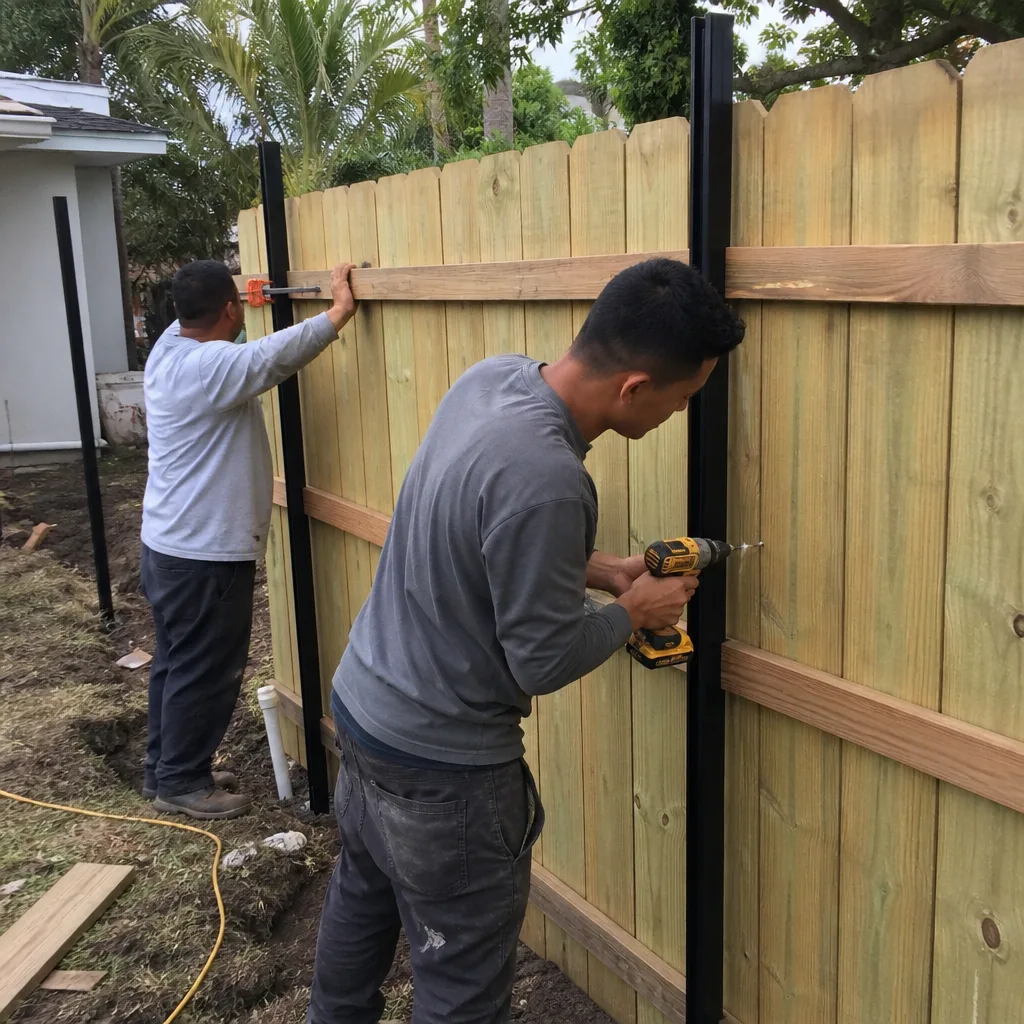
What we see across Fence Installation in Miami jobs is not a material shortage problem. It’s a specification problem. Crews buy what the nearest distributor stocks and install to tolerances learned somewhere with mild summers. That’s how a fence that should last 20 years warps inside one hurricane season.
Why “maintenance-free” is a half-truth in Miami
Both materials get sold as maintenance-free. In most of the country that’s close enough. Here it isn’t. Miami runs a UV index near 11 for much of the year, salt sits in the air from the coast inland for miles, and afternoon rain pools on horizontal surfaces for hours. That combination hits vinyl and aluminum in different places.
How vinyl degrades under Miami sun and salt
Ultraviolet light breaks down the polymer chains in vinyl over time. Without a stabilizer, the surface chalks (a fine powder that rubs off on your hand) and shifts toward a dull yellow. Within a half mile of the water, salt spray plus sun accelerates micro-cracking on the panel face. Premium cellular PVC made with a titanium dioxide UV inhibitor holds up far better than the bargain extrusions that show up on discount jobs. The difference is in the resin, and it’s invisible until year four.
How aluminum behaves near the coast versus inland
Aluminum forms its own oxide layer, which is why it resists rust so well. Near Brickell and the waterfront, a marine-grade powder coat adds a second barrier that salt spray can’t get under. That’s a genuine advantage over vinyl in salt air. Twenty blocks inland, the story changes. Aluminum is still fine, but it’s no longer the corrosion winner by much, and the open-picket design trades privacy you may actually want. That’s where premium vinyl earns its place.
Flood zones change the answer, and most comparisons skip it
This is the part almost no fence comparison mentions. FEMA’s flood-zone design guidelines for AE-zone properties require fences to allow floodwater to pass through without blocking flow. A solid vinyl privacy panel fails that requirement. An open-picket aluminum fence or a pool-code aluminum panel passes it. On certain Miami-Dade lots, that makes aluminum the only code-compliant option no matter what you’d prefer to look at.
Miami-Dade is the only place in the U.S. with its own product-approval system: the NOA number. It applies to roofs, windows, and shutters, and fence assemblies near the coast fall under the same wind and flood scrutiny. If you’re in a VE zone, the design conversation gets stricter still. A contractor who skips the flood-zone question is guessing. We ask it before we quote.
Thermal expansion and wind load: the two numbers crews get wrong
Vinyl is not rigid. That’s fine up to a point, and dangerous past it. Surface temperature on a dark, south-facing vinyl fence in direct Miami sun can reach 160°F. The material expands measurably, which means post connections need wider expansion gaps than a crew trained in Ohio would ever leave. Install it tight and the panels bow by the end of the first summer. We see this constantly on fences installed by crews who moved south and kept the old tolerance.
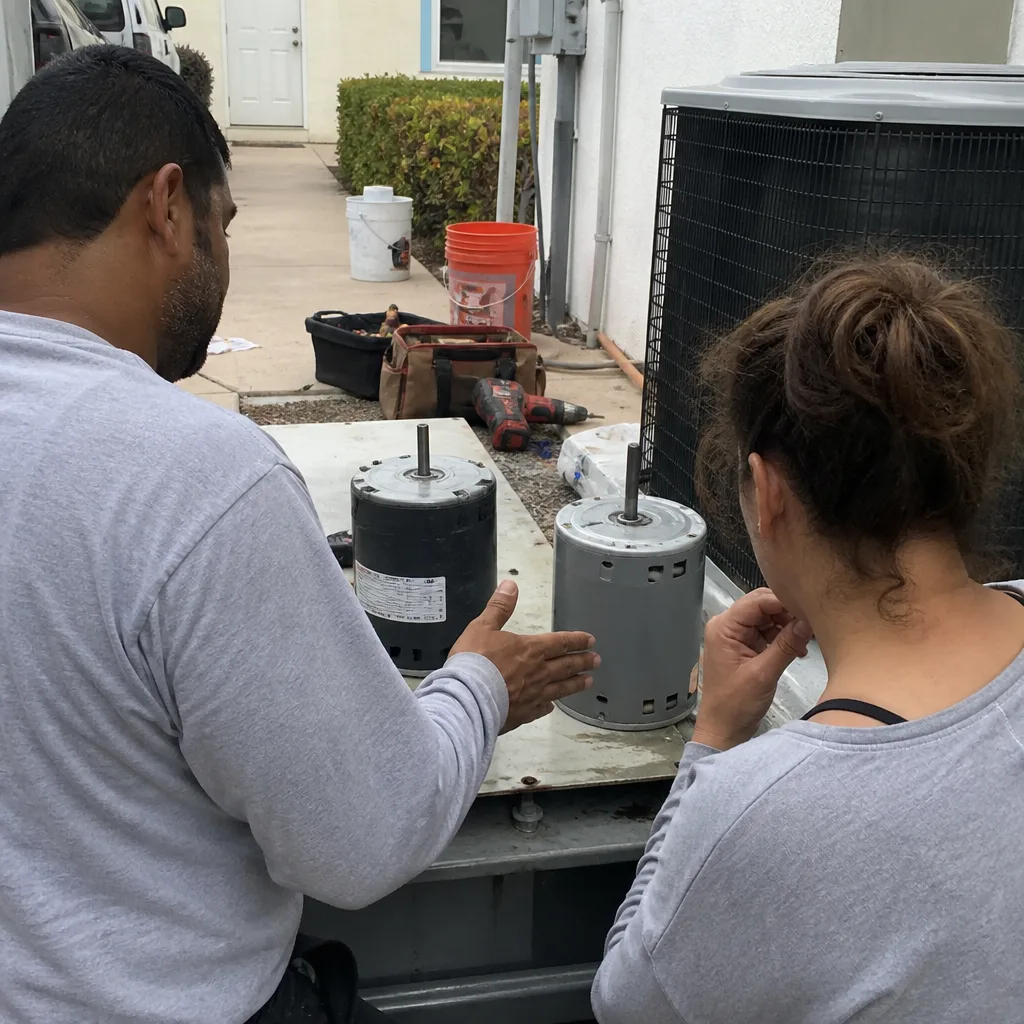
Wind is the other half. Aluminum is structurally stiffer than vinyl under wind pressure. For homes in Exposure Category D (the coastal exposure), aluminum is what we specify for ornamental fencing applications, because flex that’s acceptable at 110 mph becomes a liability at the design wind speeds Miami-Dade actually requires. Vinyl can meet the load with proper post spacing and thicker profiles. It just leaves less room for error.
Side-by-side: vinyl vs aluminum for a Miami lot
| Factor | Premium Vinyl (cellular PVC) | Marine-Grade Powder-Coated Aluminum |
|---|---|---|
| Salt-air performance (within 0.5 mi of water) | Chalks and micro-cracks over time | Strong – oxide layer plus coated barrier |
| UV yellowing risk | Controlled with titanium dioxide inhibitor; high without it | Minimal |
| Flood-zone (AE/VE) compliance | Closed panel fails flow-through | Open picket or pool panel passes |
| Wind stiffness (Exposure D) | Adequate with careful post spacing | Stiffer; the specified choice coastally |
| Thermal expansion | High – needs wide expansion gaps at posts | Low |
| Privacy | Excellent, closed panel | Limited unless using privacy slats |
| Typical installed range (Miami) | $4,130-$10,620 | $4,720-$11,800 |
Common Miami scenarios, and what we recommend
Every lot is different, but these are the four patterns that come up most often. They’re worth running against your own property before you pick a material.
- Waterfront or near-coast (Brickell, Miami Beach, Coconut Grove within a half mile of the bay): aluminum with a marine-grade powder coat. Vinyl’s salt-plus-UV failure mode is real here, and an open picket or pool panel also satisfies flood-flow rules.
- Inland family lot (Kendall, Hialeah, Westchester): premium cellular PVC vinyl. Salt is less of a factor, you get closed-panel privacy, and a well-specified vinyl fence handles the thermal swings fine. Specify the UV inhibitor.
- AE flood zone with an existing privacy fence: aluminum open-picket. Your old vinyl panel is likely obstructing flood flow, which the county notices at recertification.
- Exposure D coastal lot facing an open fetch: aluminum, specified for wind, not chosen for looks. This is where we don’t compromise.
Groundwork Construction Co. of Miami specifies premium cellular PVC with a titanium dioxide UV inhibitor for vinyl work and marine-grade powder-coated aluminum for coastal projects. We pick by the lot, not by what’s sitting in the nearest warehouse. We also pair fence specs with the same material partners we use across trades, from GAF and CertainTeed on roofing to the finish brands we trust elsewhere. Every fence install is covered by our 730-Day Done Right Promise – if it’s not done right, we make it right.
Our technicians have up to 12 years of experience, arrive background-checked and in uniform, and quote upfront pricing where the number you see is the number you pay. You can see how this fits the rest of our work on the home page, and if you’re planning a broader yard or driveway upgrade, pair the fence with Fence Installation and our Fence Installation in Miami guide.
FAQs
Vinyl fence installation in Miami typically runs $4,130-$10,620, and aluminum runs $4,720-$11,800. Aluminum usually costs more because of the powder coat and stiffer posts, and vinyl climbs in price with thicker profiles and higher privacy heights. Call (833) 968-1198 for an exact quote – estimates are free.
Yes, within roughly half a mile of Biscayne Bay or the Atlantic, aluminum with a marine-grade powder coat holds up better than vinyl. Salt spray plus Miami’s UV combines to chalk and micro-crack vinyl, while aluminum’s oxide layer resists both. Inland, premium vinyl is a strong choice and often the more practical one.
Often yes. FEMA’s flood-zone design guidelines for AE-zone properties require fences to allow floodwater to pass, and a closed vinyl privacy panel doesn’t. Open-picket or pool-panel aluminum passes. If your lot is in an AE or VE zone, we check this before quoting anything.
Usually no – a full fence install takes a scheduled day or two depending on run length and gates. What we can do same-day is give you a free estimate and a material recommendation for your lot. Call (833) 968-1198 and we’ll find a time that works.
Get a straight answer for your lot
If you’d rather have it looked at than figure it out from a chart, Groundwork Construction Co. of Miami offers a no-pressure assessment in Miami – we’ll check your flood zone, sun exposure, and wind exposure and recommend the material that fits. Call (833) 968-1198 for a free estimate.
Written by the team at Groundwork Construction Co. of Miami, serving Miami, FL.