
 Roofing
 Kitchen remodeling
 Bathroom remodeling
 Home additions & ADU
 Windows & doors
 Driveway & pavers
 Fence
Free written scope consultation - allowances, timeline, and change-order rules on paper before a single trade is scheduled
Styles & brands we work with
- Kitchen remodeling
- Bathroom remodeling
- Home additions & ADU
- Roofing
- Windows & doors
- Driveway & pavers
- Fence
See the difference
 Before
 After
 Before
 After
 Before
 After
The Best Roofing Material in Miami, FL Is the One That Passes Miami-Dade First
Choose modified bitumen or standing-seam metal for a flat or low-slope CBS home, and choose NOA-approved concrete or clay tile for a Mediterranean Revival with a pitched roof. Unless your building sits in a FEMA VE or AE flood zone or fails a 40-Year Recertification inspection, those two paths cover most of Miami. The real answer isn’t “what’s best” in the abstract. It’s “which Miami-Dade NOA-approved material fits your roof’s slope, your home’s age, and your flood zone.” Call (833) 968-1198 and we’ll walk your roof with you.
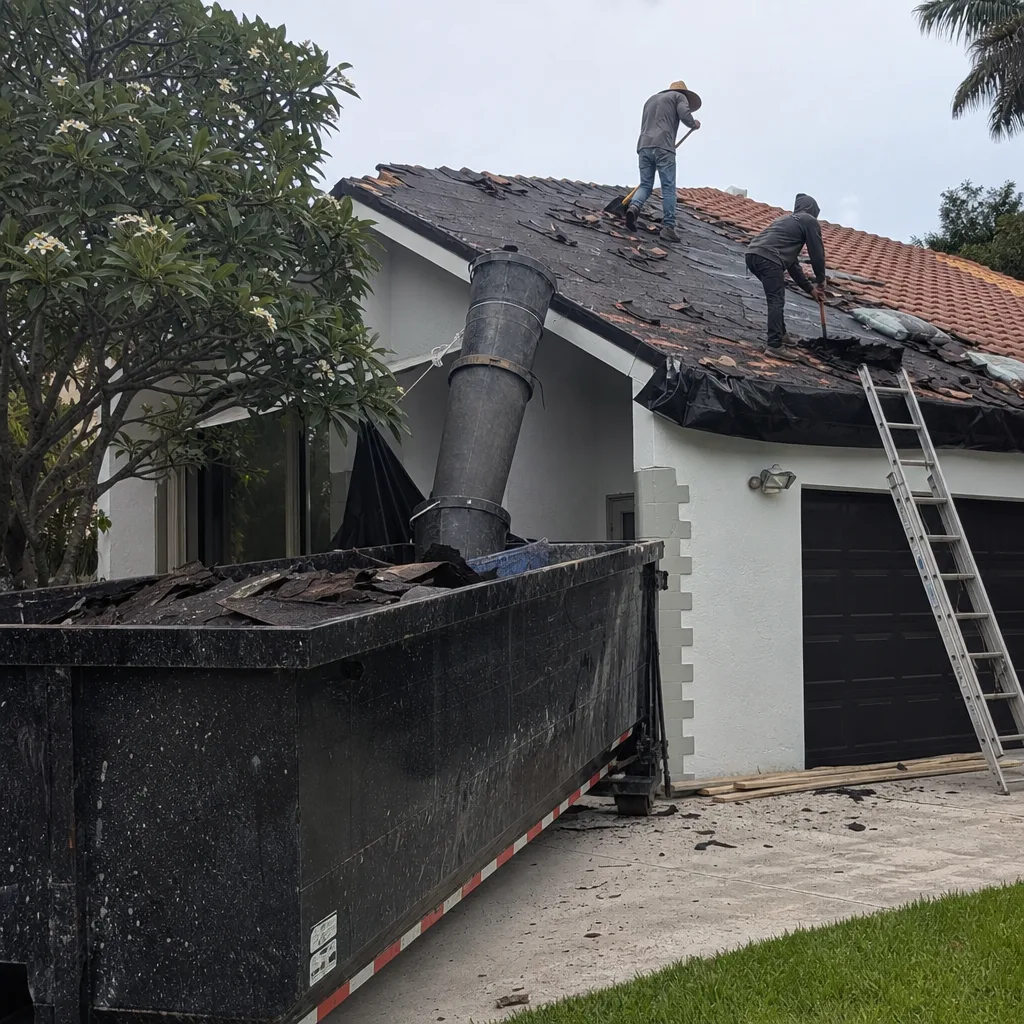
Every “best roofing material” list online was written without Miami-Dade’s NOA system in mind. Here, the building department makes the first cut, not the blogger, and that changes the entire comparison. Miami-Dade County is the only place in the US with its own product-approval system: every roof assembly has to carry a Miami-Dade Notice of Acceptance number, not just a Florida or national approval, because we sit inside the High Velocity Hurricane Zone. So the shortlist shrinks before aesthetics ever enter the room.
What to Look For, In the Order That Actually Matters
Here’s the honest decision framework we use, in the order it constrains your options. Start with slope, because it eliminates half the field. Then structure and age, because a 1960s CBS home and a post-2000 build carry different uplift and deck requirements. Then flood zone. Then, and only then, energy performance and color.
- Slope first. Flat and low-slope roofs can’t take tile or shingle without a build-up. They want modified bitumen or a standing-seam metal system.
- Age and structure second. Much of Miami’s pre-1970s stock is unreinforced masonry with flat or low-slope roofs, so a re-roof routinely triggers wind-mitigation and structural upgrades you didn’t budget for.
- Flood zone third. If you’re in a FEMA VE or AE zone, the elevation certificate and how the roof deck ties to the wall assembly become first-order criteria, not a footnote.
- Energy fourth. Miami gets more solar radiation than almost any US city. A cool-roof-rated material with a high SRI can pull attic temps down 20-30°F, and that shows up on your AC bill 10 months a year.
- Curb appeal last. NoA approval and correct installation beat a pretty profile that fails an inspection.
A Miami Decision Matrix: Which Material Fits Your Roof
This is the part national guides skip. Match your home against the rows below and you’ll have your shortlist in about a minute.
| Your Home | Slope / Structure | Material Shortlist | Typical Miami Cost |
|---|---|---|---|
| 1960s CBS concrete-block, flat or low-slope | Minimal slope, masonry | Modified bitumen or standing-seam metal | Roof replacement $9,440-$23,600; metal $17,700-$47,200 |
| 1920s Mediterranean Revival with a pitched roof | Barrel-tile profile, pitched | NOA-approved clay or concrete tile | Tile repair $710-$2,950; full tile replacement in the roof-replacement range |
| Post-2000 build in a coastal VE/AE zone | Engineered uplift, elevated deck | Impact-rated metal or tile with elevated deck specs | Metal $17,700-$47,200; assessment varies by deck |
| Any home with active leaks or storm damage | Repair before replace | Targeted repair, then re-evaluate | Roof repair $470-$2,125 |
Notice that slope and structure decide the shortlist before color or style gets a vote. That’s the difference between a real recommendation and a magazine spread. If your home is a Brickell high-rise unit rather than a single-family roof, the conversation is different, so see our Miami service area page for how we scope work across the city.
The Two Things No National Guide Tells You
Flood zone and sun exposure. Those are the variables that separate a Miami roof from the same material installed in Charlotte.
Why flood zone changes the roof deck, not just the walls
In FEMA VE or AE zones, an elevation certificate and the way your roof deck is fastened to the wall assembly raise the bar on structural uplift performance. A material that scores well on wind uplift but installs with a lighter fastening pattern may not clear the requirement for your zone. Salt-laden coastal air piles on top of that, degrading underlayments, sealants, and exterior finishes faster than inland. This matters most along Brickell and Biscayne Boulevard, where the post-2000 glassy towers and older low-rise stock sit side by side.
Why a cool roof pays for itself here
Miami’s sun is relentless. A high-SRI cool-roof material can hold attic temperatures 20-30°F lower, and that directly cuts AC runtime in a city where cooling is nearly a year-round expense. On flat CBS roofs, a white modified bitumen cap sheet is often the simplest win. On pitched tile, lighter-profile NOA-approved concrete tile does the same job while keeping the Mediterranean look your block expects. Either way, the energy spec and the NOA spec have to line up before you sign anything.
How Materials Compare, Side by Side
Brand quality matters, but only after the material clears the NOA cut. We partner with GAF and Owens Corning for roofing systems. Both offer Miami-Dade NOA-approved product lines, and both back their products with manufacturer warranties that layer on top of our own 730-Day Done Right Promise, so you’re covered by two warranties instead of one.
| Material | Best For | Watch Out For |
|---|---|---|
| Modified bitumen | Flat and low-slope CBS homes from the 1960s | Degrades fast in intense UV if the topcoat and underlayment aren’t up to spec |
| Standing-seam metal | Low-slope and coastal homes, long service life | Higher upfront cost; fastening pattern must match your uplift requirement |
| NOA-approved concrete tile | Mediterranean Revival pitched roofs | Weight needs structural verification on older homes |
| Clay tile | Historic Miami Modern and Revival profiles | Brittle under impact; repair rather than full replacement when possible |
If you want the full scope of what a re-roof involves in this market, our Roofing service page lays out the process, and a roof replacement guide covers how the deck and underlayment get handled. For flat-roof specific work, a flat roof overview is worth reading before you get bids.
Where Groundwork Fits In
Groundwork Construction Co. of Miami connects homeowners with independent local professionals who do the work, and we hold those crews to a written standard. Every technician is background-checked and arrives in uniform. Our technicians have up to 12 years of experience, and every call is answered by a live person, 24/7. Pricing is upfront, no surprises: the number you see is the number you pay. Projects over $10,000 get $1,000 off, and 0% financing for 18 months makes a larger re-roof accessible without hidden fees. All of it is covered by the 730-Day Done Right Promise: if it isn’t done right, we make it right.
Why does that matter for material choice? Because the best material installed by a crew that vanishes is a bad roof. The comparison that wins is the one where the installer outlasts the product warranty. If you’d like to compare materials for your own home, we’d be glad to walk your roof and give you the shortlist for your slope, age, and flood zone. You can reach our broader construction work through our home page, or browse related help on metal roof installation, tile roof repair, and roof inspections for the older stock around town.
FAQs
For a flat or low-slope CBS home, modified bitumen and standing-seam metal are the two strongest picks, and metal wins on service life while modified bitumen wins on upfront cost. The deciding factor is whether your deck and fastening pattern clear the uplift requirement for your flood zone.
Yes. If you’re in the High Velocity Hurricane Zone, every roof assembly has to carry a Miami-Dade Notice of Acceptance number, not just a Florida or national approval. That’s the first filter before you compare materials or prices, and a material without one won’t pass inspection.
A roof replacement in Miami typically runs $9,440-$23,600, with metal installations in the $17,700-$47,200 range and minor repairs at $470-$2,125. The spread reflects slope, flood zone, and whether the deck needs structural work. Call (833) 968-1198 for an exact quote, and estimates are free.
It can, and the effect is real. A high-SRI cool-roof material can pull attic temperatures down 20-30°F, which cuts AC runtime in a city that cools nearly year-round. The size of the savings depends on your insulation and attic ventilation, so we check both before recommending a material.
If the damage is localized to a few tiles or a small section of membrane, repair at $470-$2,125 is almost always cheaper. Once leaks or storm damage spread across more than a few square feet, replacement usually costs less than repeated patches. We’ll show you both numbers before you decide.
If you’d rather have it looked at, Groundwork Construction Co. of Miami offers a no-pressure assessment in Miami: we walk the roof, confirm your NOA requirements, and hand you a shortlist with upfront pricing. Call (833) 968-1198 to schedule your free estimate.
Written by the team at Groundwork Construction Co. of Miami, serving Miami, FL.