

 Fence
 Kitchen remodeling
 Bathroom remodeling
 Home additions & ADU
 Roofing
 Windows & doors
 Driveway & pavers
Free written scope consultation - allowances, timeline, and change-order rules on paper before a single trade is scheduled
Unilock Fence Installation: The Miami Owner’s Guide
Unilock fence installation in Miami typically runs $4,130 to $10,620 for a full residential run, depending on linear footage, wall block style, and site access. In most cases we can assess your property and get you a written, line-item estimate on the same visit. Homeowners usually call us after they notice one of three things: leaning panels that tilt further every rainy season, block courses that have separated at the joints, or a fence line that no longer sits level along the property edge.
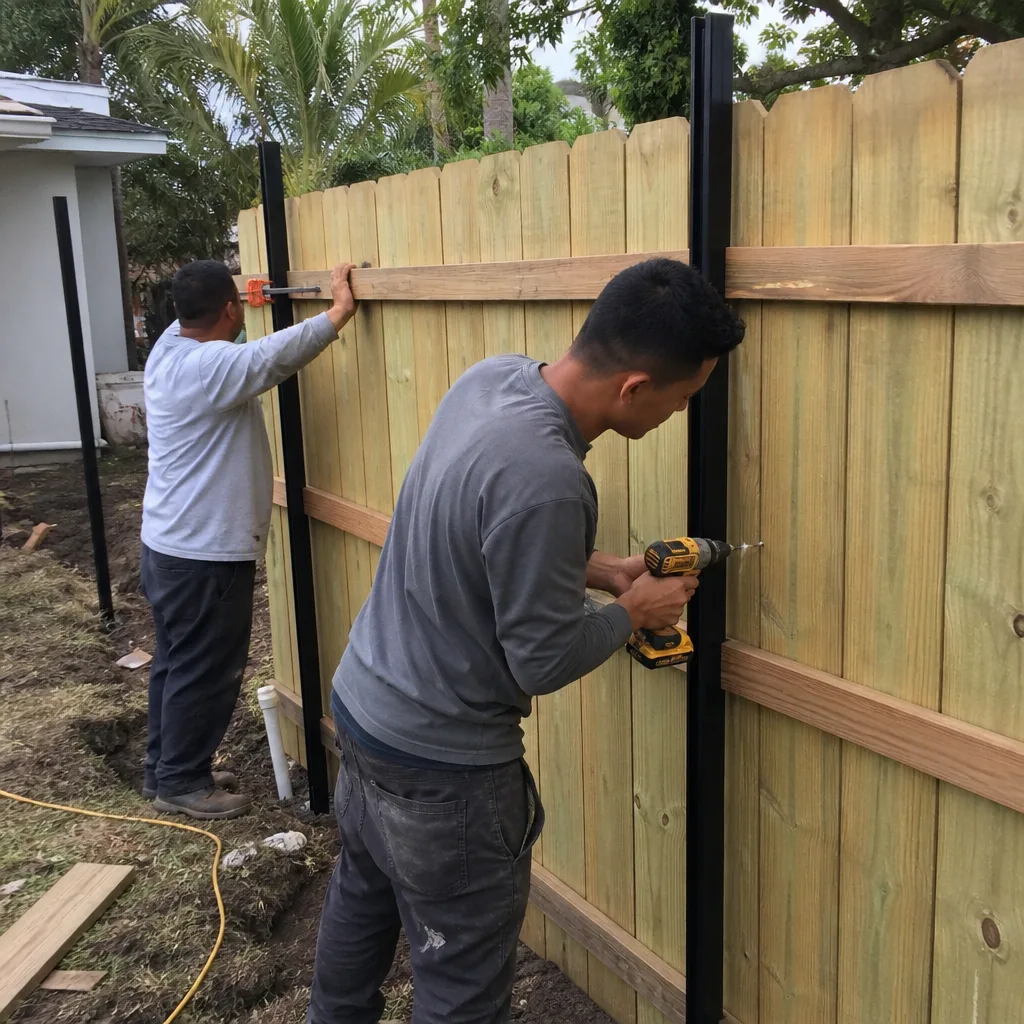
Miami’s climate makes this failure pattern predictable. Between the May-through-October downpours and the salt air moving in off Biscayne Bay, improperly footed fence systems start showing stress within a couple of seasons. If your Unilock fence is already leaning, cracked, or pulling apart, that’s the signal to act before the next storm season rolls through.
Key Takeaways
- Unilock fence installation in Miami runs $4,130 – $10,620 installed, with written upfront pricing.
- Most fence failures in South Florida trace back to footing depth, drainage, or missing reinforcement, not the block itself.
- Every job is backed by our 730-Day Done Right Promise.
- Call (833) 968-1198 and a live person answers around the clock.
Which Unilock Models This Applies To
Unilock makes several fence and wall systems, and the installation approach differs meaningfully between them. The most common residential lines we encounter are the Brussels Dimensional Wall family, Nicolock wall blocks (Unilock’s sister brand), and U-Cara multi-piece wall systems. If your fence uses a stacked block column with capstones on top, you’re likely looking at a Brussels-style system. If the panels are made from a textured, multi-sized stone pattern, it’s more likely U-Cara.
To identify what you have, look at the back face of a block near the bottom course or check the underside of a capstone. Unilock stamps its blocks with a brand mark and often a mold code. Measure the block’s face dimensions (Brussels is typically 4×8-inch face units in a course) and photograph the joint pattern. That combination tells us which system we’re matching.
Here’s the compatibility gotcha most homeowners miss: wall blocks change mold specs between production runs, so a newer block from the same product line may be a slightly different thickness or texture than what’s already in your fence. On repair work, we always verify color and dimension match by physical sample before ordering. On a full replacement, that’s a non-issue. On a partial repair, it can mean the difference between a seamless tie-in and a visible patch.
On the OEM-versus-aftermarket question: for Unilock specifically, we source through authorized Unilock dealers. The product has strong color-match and dimensional consistency within a production batch. Aftermarket lookalikes frequently miss on color and won’t weather the same way, and the price difference rarely justifies it on a fence you plan to keep.
Styles & brands we work with
- Kitchen remodeling
- Bathroom remodeling
- Home additions & ADU
- Roofing
- Windows & doors
- Driveway & pavers
- Fence
Signs Your Unilock Fence Installation Is Failing
Every failing Unilock fence we look at in Miami tells us something about how it was originally installed. Here’s what to watch for and what’s usually behind it.
- Panels leaning outward or inward. This almost always traces back to shallow footings. In Miami’s sandy, high-water-table soils, a footing needs to extend below the seasonal moisture line. If the original installer set 12-inch footings where 18 to 24 inches was called for, the fence will move with the first wet season and never really stop.
- Separated or open joints between courses. You’ll see daylight through the vertical joints or a stepping gap developing. This usually means the base course wasn’t compacted correctly or the first course wasn’t leveled to the footing, and the fence has been slowly shifting since day one.
- Cracked blocks or spalled faces. Florida’s freeze-free climate doesn’t cause frost damage, but repeated wet-dry cycling and salt spray do degrade improperly sealed block faces over time. Cracking often starts near the capstone where water gets behind the block.
- Capstones rocking or missing. Capstones are usually set with adhesive. On an older fence, the adhesive has failed and water is getting behind the cap, which then feeds moisture into the wall core. This is one of the most common repair items we see in Miami.
- Drainage pooling along the fence base. If water stands against the base of your fence after a heavy rain, the footing is being undermined from the outside. This is a design problem more often than an installation problem, and it needs to be addressed alongside the fence repair or the fence will fail again.
See the difference
 Before
 After
 Before
 After
 Before
 After
Replacement Cost & What’s Included
Unilock fence installation in Miami comes in at $4,130 to $10,620 installed. That’s the honest range for a typical residential run with standard footing work and one gate. Here’s what drives you toward the top of that range:
- Linear footage. The biggest variable, by far. A 60-foot run and a 120-foot run are different projects.
- Site access. Fence lines that back against canal banks, dense landscaping, or a tight Coral Gables lot with no equipment access mean more hand labor.
- Footing depth and soil conditions. In areas of Miami-Dade with high water tables or fill soils, footing prep costs more.
- Wall block style. Premium Unilock systems like U-Cara with multi-piece construction cost more in material than a straightforward Brussels Dimensional Wall.
- Gates and columns. Each gate frame and each structural column is an added cost line.
Every job gets a written, line-item estimate before any work begins. What that quote says is what you pay. No change orders for material overages we didn’t anticipate.
You can also bundle your Unilock fence with a paver driveway or patio project. We install Unilock and Belgard hardscape products across Miami, and multi-scope projects get a single estimate. We also work with cabinetry and stone brands like KraftMaid, Cambria, and Silestone on interior projects if you’re already in planning mode.
DIY or Call Us?
Some things you can safely check yourself. Grab a 4-foot level and hold it against a few fence panels. Walk the base of the fence after a heavy rain and note where water stands. Take photos of any lean, cracking, or open joints and measure how much displacement you’re seeing. Check the capstones for rock and look at the bottom course for mortar or adhesive failures.
What we don’t recommend is digging up footings or trying to reset leaning panels yourself. Unilock wall systems are heavy (a full block can run 30 to 50 pounds) and the footing work requires soil understanding specific to Miami-Dade’s fill soils and water table. A fence panel that tumbles during a DIY reset can cause serious injury, and a re-set panel that isn’t re-footed correctly will be leaning again before the next summer.
Installation also requires proper base compaction, footing depth, reinforcement placement, and drainage planning. That’s not something you pick up from a video. Call us at (833) 968-1198 for a free estimate, and we’ll walk your property and tell you exactly what needs to happen.
FAQs
A properly installed Unilock fence should last 25 to 30 years in Miami’s climate. The block material itself is durable; what determines longevity is footing depth, drainage, and whether the capstones are properly adhered. Fences installed with shallow footings or poor drainage often show serious failure within 7 to 10 years. Call (833) 968-1198 for an estimate and we’ll assess what you have.
Yes, in many cases. Individual panels, capstones, or sections can be repaired without replacing the entire fence. The limiting factor is color and dimensional match. If your fence is recent enough (within a few production cycles), we can usually source matching blocks. On older fences, a partial repair may require accepting a slight color variation, or we can discuss a section replacement that blends more cleanly. Call (833) 968-1198 and we’ll take a look and give you the honest answer.
A typical residential Unilock fence installation in Miami takes one to three days, depending on linear footage, site access, and gate count. Footing work is usually day one; block setting and capstone is the balance. Most jobs are completed in a single visit to the property once materials are staged. Call (833) 968-1198 to schedule a free estimate and we’ll give you a realistic timeline for your specific project.
We source Unilock materials through authorized Unilock dealers, and we verify color and dimensional match against your existing fence or against the current product spec before ordering. We do not stock parts on a truck, and we don’t claim to. Materials are ordered per project to the correct spec and staged before work begins. That’s how we avoid the mid-job material mismatch that ruins repair work. Call (833) 968-1198 for a free estimate.
Groundwork Construction Co. of Miami is an independent installer and is not affiliated with Unilock. Unilock is a registered trademark of its respective owner.
Ready to get your Unilock fence done right? Call Groundwork Construction Co. of Miami at (833) 968-1198 for a free estimate. Your call is answered by a live person 24 hours a day, seven days a week. You’ll get a written, line-item estimate with no surprises, and every installation is backed by our 730-Day Done Right Promise. If it’s not done right, we make it right.
Written by the team at Groundwork Construction Co. of Miami, serving Miami and nearby areas.