
 Windows & doors
 Kitchen remodeling
 Bathroom remodeling
 Home additions & ADU
 Roofing
 Driveway & pavers
 Fence
Free written scope consultation - allowances, timeline, and change-order rules on paper before a single trade is scheduled
Styles & brands we work with
- Kitchen remodeling
- Bathroom remodeling
- Home additions & ADU
- Roofing
- Windows & doors
- Driveway & pavers
- Fence
See the difference
 Before
 After
 Before
 After
 Before
 After
Double Hung vs Casement Windows in Miami, FL: Which Survives the HVHZ Better?
For most Miami homeowners, choose casement windows if your priority is wind-load performance and cross-ventilation, and choose double-hung windows if you need the sash tilt-in for cleaning or your window openings are narrow and stacked. The honest reason isn’t aesthetic: inside Miami-Dade’s High Velocity Hurricane Zone, casement windows often carry higher design-pressure ratings than double-hungs from the same manufacturer, because the sash seats tighter against the frame as wind load increases. Getting the right answer for your specific wall means checking the NOA number, not just the catalog photo. Call (833) 968-1198 and we’ll walk your openings with you before you commit.
Why Miami’s HVHZ Rewrites the Usual Advice
Miami construction is defined by the High Velocity Hurricane Zone – Miami-Dade County runs the only product-approval system of its kind in the US, so every window has to carry a Miami-Dade NOA (Notice of Acceptance) number, not just a Florida or national approval. That changes the double-hung vs casement conversation entirely.
Here’s the part most comparison articles skip: casement windows actually get stronger in a hurricane. The wind pressure that would force a double-hung sash off its track pushes a casement tighter into its frame. It’s not marketing language – it’s why casements from the same manufacturer routinely post higher positive design-pressure ratings in the NOA database.
When we specify windows through our Windows & Doors service line, that rating is the first thing we check against your wall orientation and exposure category. A north-facing wall with shielding from a neighboring building may pass with a lower-rated unit; a corner lot with open exposure to Biscayne Bay often won’t.
The Ratings Behind the Recommendation
Miami-Dade’s NOA database is public, and it’s the fastest way to settle the argument for your house. Here’s roughly what we see when we pull product approvals for residential units:
| Rating | Typical Double-Hung | Typical Casement |
|---|---|---|
| Positive design pressure | +40 psf | +60 psf and up |
| Negative design pressure | −50 psf | −70 psf and up |
| Seal mechanism under load | Sliding interlock | Compression seal against frame |
| Water infiltration path | Horizontal sash channels | Fewer ledges, faster drain |
| Best suited to | Narrow or stacked openings | Wide walls, wind exposure, ventilation |
Two things matter here. First, a higher psf number only protects you if the unit is installed to the NOA’s requirements – including the anchor pattern and the buck framing. Second, a casement that outrates a double-hung on paper can still fail inspection if the rough opening wasn’t built for it.
The unit itself isn’t the whole story, either. A NOA-rated window in a misanchored opening is a failed install waiting for the first named storm. We approach the home as a system: the rough opening, the flashing, the buck, the anchor schedule, and the product all have to line up for the rating to hold.
Pre-1970s CBS Openings: Where the Choice Actually Gets Made
A lot of Miami’s housing stock predates 1970: dense blocks of concrete-block and CBS homes, plus 1920s Mediterranean Revival and MiMo buildings, with a post-2000 wave of glassy high-rises along Brickell and Biscayne Boulevard layered on top. That 40-Year Recertification deadline creates a predictable wave of work as buildings hit their inspection cycle.
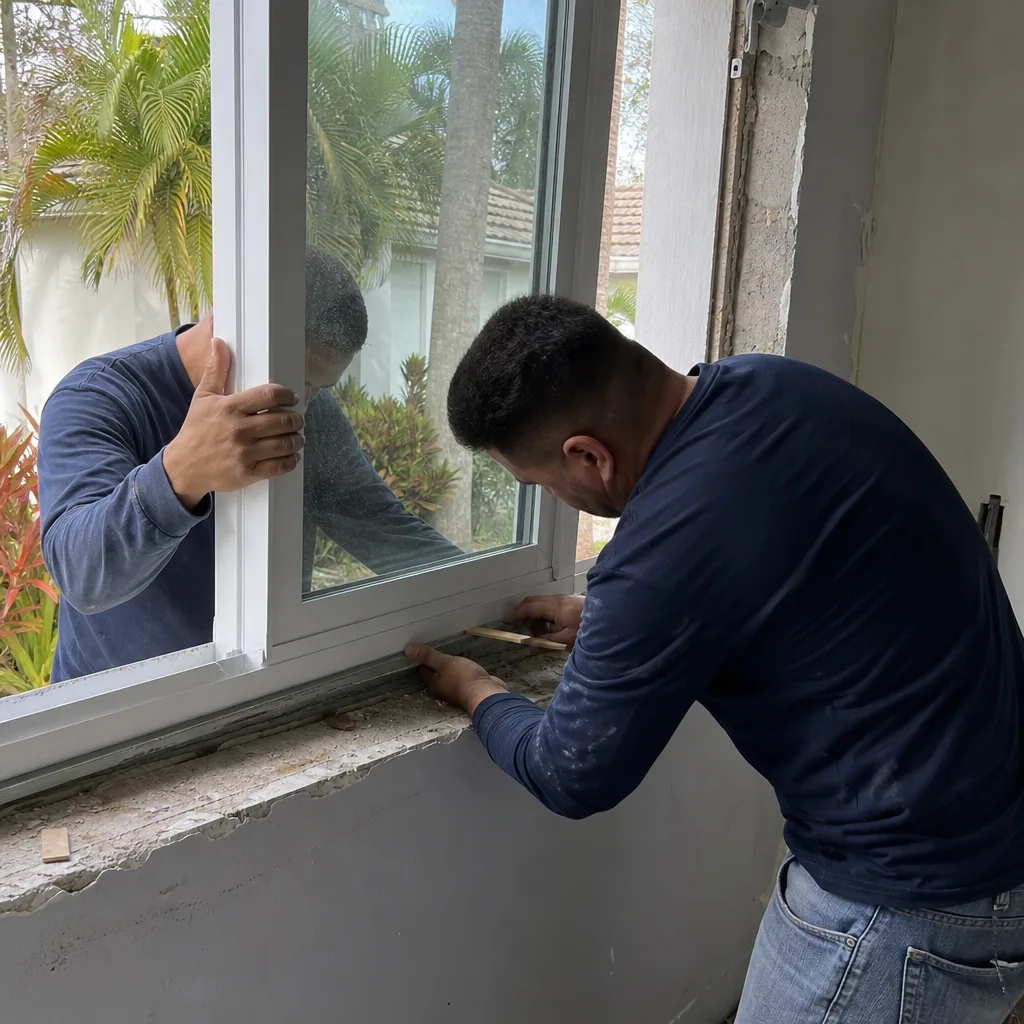
For a typical pre-1970 CBS home, the rough opening was almost certainly built for jalousie or single-hung aluminum frames. Casement installations in these openings need a different buck framing detail than double-hungs because the sash swings and seals on a different plane. Get that detail wrong and you void the NOA – the window passes the lab and fails the inspection.
What we look at before recommending either window
- Wall orientation and exposure: southeast-facing walls catch the trade winds and the worst of the storm-driven rain.
- Rough opening dimensions and condition: concrete-block walls sometimes need repair before either unit goes in.
- Buck framing: casement installs need the right framing detail to keep the NOA valid.
- Anchor pattern: the NOA specifies it; the inspector checks it.
- Hardware clearances: crank and screen swing on casements needs clearance the opening may not have.
- Maintenance reality: double-hung channels collect mold and moisture in Miami’s year-round humidity faster than casement frames.
Salt-laden coastal air, intense sun, and daily afternoon thunderstorms are hard on windows here. Casements drain more efficiently in that cycle simply because they have fewer horizontal ledges where water sits. That’s a small thing that adds up over a decade.
Ventilation: The Casement Advantage You Can Measure
Miami’s subtropical climate gives casements a second edge: cranked open, a casement can be angled to catch the prevailing southeast trade winds. The air actually enters the room instead of pressing against the glass. A dual win – the sash catches breeze on one side and acts as a deflector on the other. On an energy audit, that passive cooling shows up in reduced AC runtime during the shoulder months. Not enormous, but real.
Double-hungs are no slouch on ventilation either; that’s their historical strength. The difference is that casements capture and direct the breeze, while double-hungs rely on the opening itself. For Miami’s specific wind direction, casements usually win on this point.
Brands, Installation, and What Groundwork Actually Does
We install Andersen and Marvin casement and double-hung lines, both NOA-approved for Miami-Dade. Our technicians have up to 12 years of experience, they’re background-checked and arrive in uniform, and they pull the permit and handle the inspection – so the rating on the label matches the rating on the building record. No surprises at final walk.
Every install is covered by our 730-Day Done Right Promise: if it’s not done right, we make it right. That’s one of the longest workmanship guarantees in residential construction, and it applies to window installs the same as it does to a kitchen or a roof.
Pricing runs in the same ranges as our broader window work. Replacement windows in Miami typically land between $5,310 and $17,700 depending on unit count, material, and opening complexity. Impact-rated installation runs $9,440 to $29,500, and the gap between ordinary and impact-rated units is worth a conversation before you sign anything. We carry curated brand partners across every trade, from Andersen and Marvin for windows to KraftMaid and Cambria in kitchens, so you’re choosing quality rather than what happens to be in stock.
FAQs
For most Miami walls, yes, if wind-load performance and cross-ventilation are the priority. Casements from the same manufacturer typically post higher positive design-pressure ratings – roughly +60 psf vs +40 psf for double-hungs – because the sash compression-seals against the frame under load rather than relying on a sliding interlock. The exception is narrow or stacked openings where a casement hasn’t got room to crank open. Call (833) 968-1198 to check your specific walls.
Under wind load, yes, they hold up well because the pressure pushes them tighter into the frame, and that’s exactly why they score higher in the NOA database. The catch is installation. A casement that isn’t anchored and bucked to the NOA spec fails inspection even if the product itself is top-rated. Product and install have to match. Estimates are free – call (833) 968-1198 for an exact quote on your home.
Replacement windows in Miami typically run $5,310 to $17,700 depending on count, material, and opening complexity, with impact-rated installs running $9,440 to $29,500. Casements aren’t inherently more expensive per unit than double-hungs of similar quality, but they do sometimes require extra buck framing in older CBS openings, which adds a modest amount. Call (833) 968-1198 for a straight number before you commit – upfront pricing, no surprises.
Usually, yes – a proper buck framing detail lets us adapt the existing rough opening to a casement without structural changes. Concrete-block walls sometimes need minor repair around the opening first, and we’ll flag that during assessment so there are no surprises mid-job. Our technicians pull the permit and handle inspection so the install stays compliant. Call (833) 968-1198 and we’ll walk the openings with you.
If you’d rather have it looked at, Groundwork Construction Co. of Miami offers a no-pressure assessment in Miami – call (833) 968-1198. Live person, 24/7, and we’ll pull the NOA records for your address before we recommend a single window.
Written by the team at Groundwork Construction Co. of Miami, serving Miami, FL.