
 Kitchen remodeling
 Bathroom remodeling
 Home additions & ADU
 Roofing
 Windows & doors
 Driveway & pavers
 Fence
Free written scope consultation - allowances, timeline, and change-order rules on paper before a single trade is scheduled
Styles & brands we work with
- Kitchen remodeling
- Bathroom remodeling
- Home additions & ADU
- Roofing
- Windows & doors
- Driveway & pavers
- Fence
See the difference
 Before
 After
 Before
 After
 Before
 After
JADU vs. Standard ADU in Miami, FL: Which One Actually Clears Miami-Dade Faster?
Choose a JADU if you want the fastest legal path to extra living space on a lot you already own, you plan to keep living on the property, and $1,200-$1,800/month in rental income is enough to move your numbers. Choose a standard ADU only if you need the full $1,800-$2,800/month revenue ceiling, up to 1,000 square feet of separate living space, or a building a tenant can occupy while you live somewhere else. In Miami, that choice is less about floor plans and more about which path survives Miami-Dade’s regulatory obstacle course. The JADU route routinely clears permit review in 4-6 weeks. A detached ADU often runs 8-14. Call (833) 968-1198 and we’ll walk you through both timelines in plain English.
Why the Permit Review Timeline Diverges So Sharply in Miami
A junior ADU is carved from existing interior space inside your home, so it doesn’t trigger the full new-structure engineering review a detached ADU sets off. That single distinction changes everything about how fast you get to a stamped permit in Miami-Dade.
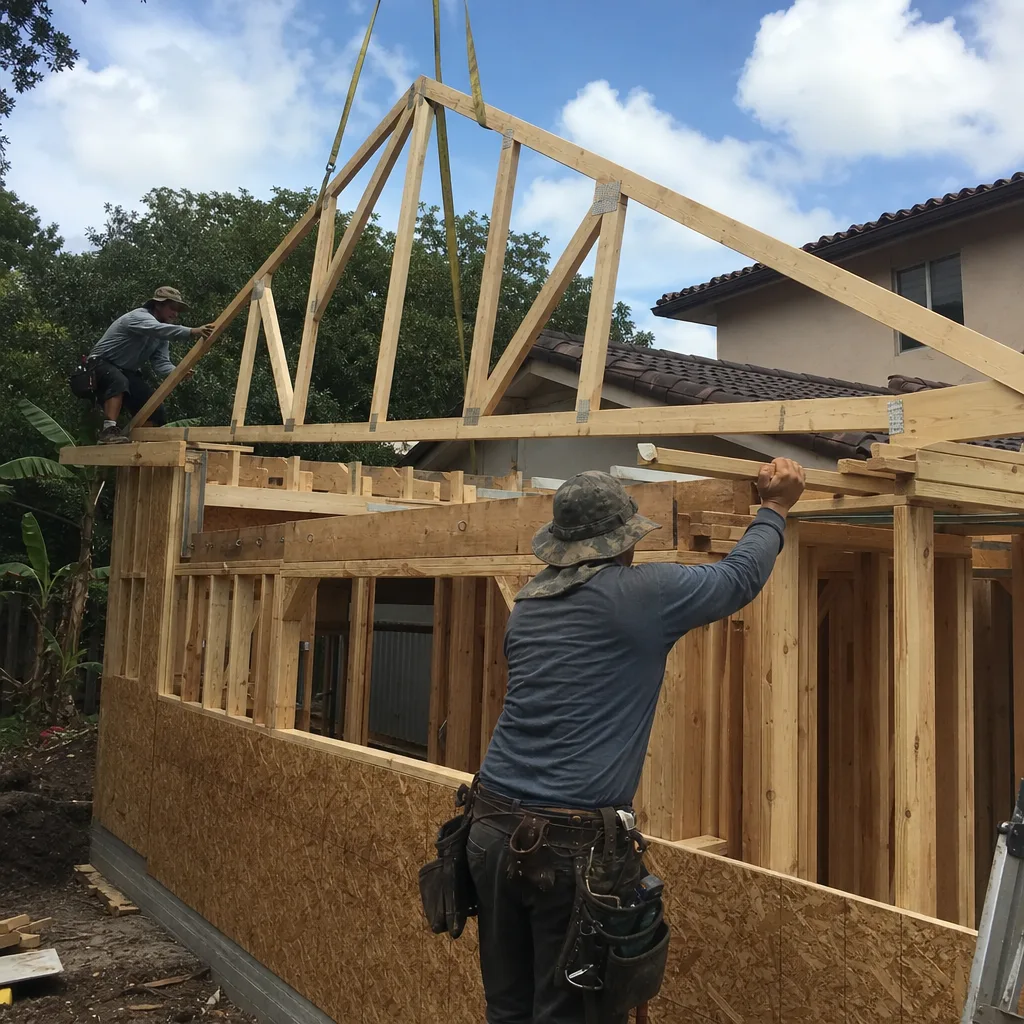
A detached standard ADU is new construction, and in Florida’s High Velocity Hurricane Zone, new construction means documented wind resistance at every step. Miami-Dade County is the only place in the U.S. with its own product-approval system. Every roof assembly, window, and shutter on that new building must carry a Miami-Dade NOA number, not just a Florida product approval or a national one. That’s wind-load engineering, impact-glass specification, and an impact-fee calculation all stacked on top of each other.
A JADU sidesteps most of that because it’s interior work inside a building that already passed its structural and wind review. You’re adding a kitchenette, a bathroom, insulation, and an egress path. The building already stands. That’s the whole reason a JADU can be permitted and built in roughly half the time of a detached ADU in Miami.
- JADU permit review: 4-6 weeks, because no new-structure engineering is required
- Detached ADU permit review: 8-14 weeks once HVHZ engineering and NOA product review are layered in
- Impact-fee calculation: triggered by detached ADU construction, generally avoided by interior conversion
- NOA-compliant roof system design: required for a detached ADU, not for a JADU’s interior scope
If your home is older, that gap widens further. Much of Miami’s pre-1970s housing stock is unreinforced masonry with flat or low-slope roofs, and adding a detached structure on that lot can pull in structural and wind-mitigation upgrades you weren’t planning for.
The Owner-Occupancy Rule Reshapes Everything Else
Here’s the clause that catches a lot of homeowners flat-footed. A JADU in Miami-Dade requires a recorded owner-occupancy covenant. That means you sign a document that binds you to living on the property. You can’t move out and rent the JADU as a fully independent unit while you live elsewhere.
A standard detached ADU under Florida law carries no such restriction. If your goal is to build an income unit and eventually move across town while it keeps paying you, the JADU is the wrong tool for the job no matter how fast the permit clears. That’s not a detail we bury in a contract. It’s the first thing we ask about when someone calls asking about a junior ADU in Miami.
The revenue ceiling is the other half of the same question. A standard ADU in Miami can run up to 1,000 square feet and rent for $1,800-$2,800/month in today’s market. A JADU is capped at 500 square feet with a kitchenette rather than a full kitchen, and it typically commands $1,200-$1,800/month. Run both against your build cost and the ROI math often favors the detached ADU over a 10-year horizon, even with the longer permit window.
Which One Fits Your Miami Home? A Housing-Stock Reality Check
Your lot and your floor plan usually make the decision for you before you weigh a single number. Here’s how it usually breaks down in Miami neighborhoods.
Pre-1970s CBS homes with large footprints and an existing side entrance are natural JADU candidates. You convert a rarely-used interior room or a rear addition into a legal junior unit, you keep the existing structure, and you lean on that side entrance for a separate way in. These homes are all over places like Shenandoah, Little Havana, and Coral Way. Older mid-century blocks with deep lots and generous interior square footage often make the JADU the faster, cleaner build.
Newer, smaller-footprint homes on tight lots are a different story. If you can’t spare the interior square footage without wrecking the way the house lives, a detached ADU is the only viable path, even with the longer review and higher cost. This comes up constantly in newer subdivisions and on infill lots where every interior room is already spoken for.
Common Miami Scenarios We See
- The multi-generational Coral Way CBS home: a rear interior suite already has a side entrance and plumbing on the same wall. JADU wins on speed and cost.
- The Shenandoah rental-goal owner: the owner wants to move out in three years and rent the unit separately. Standard ADU is the only legal path.
- The tight-lot newer build: no interior room to spare, so a detached ADU it is, engineering review and all.
- The 40-Year Recertification property: an older building due for its structural and electrical inspection uses the JADU conversion to fold in repair work and add livable space at the same time.
That last scenario is a real Miami quirk. Miami-Dade requires buildings at 40 years old (25 near the coast) to pass a structural and electrical safety inspection. Because so much of Miami’s housing stock is now crossing that line, we regularly see owners who need concrete and spall repair pulling a JADU conversion into the same permit window. It’s one mobilization instead of two, and it’s the kind of sequencing that saves real money.
Side-by-Side: JADU vs. Standard ADU in Miami
| Factor | Junior ADU (JADU) | Standard Detached ADU |
|---|---|---|
| Max size | 500 sq ft, kitchenette | Up to 1,000 sq ft, full kitchen |
| Permit review | 4-6 weeks | 8-14 weeks |
| HVHZ new-structure review | Not triggered | Required (NOA roof, impact glass) |
| Owner-occupancy covenant | Required and recorded | Not required |
| Typical rent | $1,200-$1,800/month | $1,800-$2,800/month |
| Typical build cost | $35,400-$94,400 (garage conversion range) | $106,200-$259,600 |
One more thing worth saying plainly: an ADU of any kind is a real construction project, and the structural work involved in a detached build, especially roof and wind-load work, isn’t something to attempt yourself. That’s trained-professional territory, and it’s why the HVHZ engineering review exists in the first place.
How Groundwork Construction Co. of Miami Handles Both Paths
We quote both scenarios in writing before you commit, and the number we hand you is the number you pay. Our technicians have up to 12 years of experience, arrive background-checked and in uniform, and the finished work sits under our 730-Day Done Right Promise on either path. That guarantee doesn’t change whether you build a JADU or a standard ADU. It’s the same written commitment, and it’s one of the longest workmanship guarantees in residential construction.
Calls reach a live person 24/7, so you’re not leaving a voicemail on a Friday and waiting until Monday. We also back both paths with $1,000 off projects over $10,000, a free project estimate and design consult, and 0% financing for 18 months. For the exterior side of a detached ADU, we lean on brands like ActiveYards for fencing and Belgard for hardscape so the new unit and the yard read as one finished property. If you’re still mapping the whole addition, our guide to Home Additions & ADU lays out the full scope.
We also handle the adjacent work that a JADU conversion usually pulls in: bathroom remodeling where the new suite needs a shower and vanity, kitchen remodeling if the main kitchen needs its own update while the kitchenette goes in, and roofing in Miami when the 40-Year inspection flags the roof. The point is one team handling the connected pieces instead of three contractors pointing fingers at each other.
FAQs
Yes, usually twice as fast. A JADU carved from existing interior space avoids the Miami-Dade new-structure engineering review, NOA-compliant roof design, and impact-fee calculation that a detached ADU triggers, which is why JADU review runs 4-6 weeks versus 8-14 for a detached build. Call (833) 968-1198 for a project-specific timeline - estimates are free.
No. A JADU in Miami-Dade requires a recorded owner-occupancy covenant, so you must live on the property. If your goal is a fully independent rental you can vacate and lease, a standard ADU has no such restriction under Florida law. Call us and we’ll help you pick the path that matches your plan.
A detached ADU typically runs $106,200-$259,600, while a JADU carved from an existing garage or interior space often falls in the $35,400-$94,400 range for the conversion scope. The gap comes mostly from HVHZ engineering, NOA product requirements, and new-structure cost. Call (833) 968-1198 for an itemized, upfront quote on your specific home.
A standard ADU earns more per month. A detached unit up to 1,000 sq ft rents for $1,800-$2,800/month in Miami, while a capped 500 sq ft JADU with a kitchenette runs $1,200-$1,800. Run both against build cost over ten years before you decide. Call us and we’ll put the numbers side by side in writing.
If you’d rather have it looked at, Groundwork Construction Co. of Miami offers a no-pressure assessment in Miami. We’ll review your lot, your floor plan, and both timelines so you can see the real difference in writing. Call (833) 968-1198 to schedule your free estimate.
Written by the team at Groundwork Construction Co. of Miami, serving Miami, FL.