

 Kitchen remodeling
 Bathroom remodeling
 Home additions & ADU
 Roofing
 Windows & doors
 Driveway & pavers
 Fence
Free written scope consultation - allowances, timeline, and change-order rules on paper before a single trade is scheduled
Styles & brands we work with
- Kitchen remodeling
- Bathroom remodeling
- Home additions & ADU
- Roofing
- Windows & doors
- Driveway & pavers
- Fence
See the difference
 Before
 After
 Before
 After
 Before
 After
Kitchen Island Installation Cost in Miami: What a Plumbed Island Really Adds to the Bill
Kitchen island installation in Miami runs $3,540 to $11,800 for most projects, with a freestanding island at the low end ($1,500-$5,000) and a fully plumbed-and-wired island reaching $8,000-$18,000+. The number that catches Miami homeowners off guard isn’t the cabinetry or the stone. It’s the slab. Cut into the concrete floor of a pre-1980 Coral Gables CBS home to bring water and power to that island, and you’ve triggered permits and inspections that most online price guides skip entirely. Call (833) 968-1198 and we’ll walk you through the real number for your house before anyone swings a hammer.
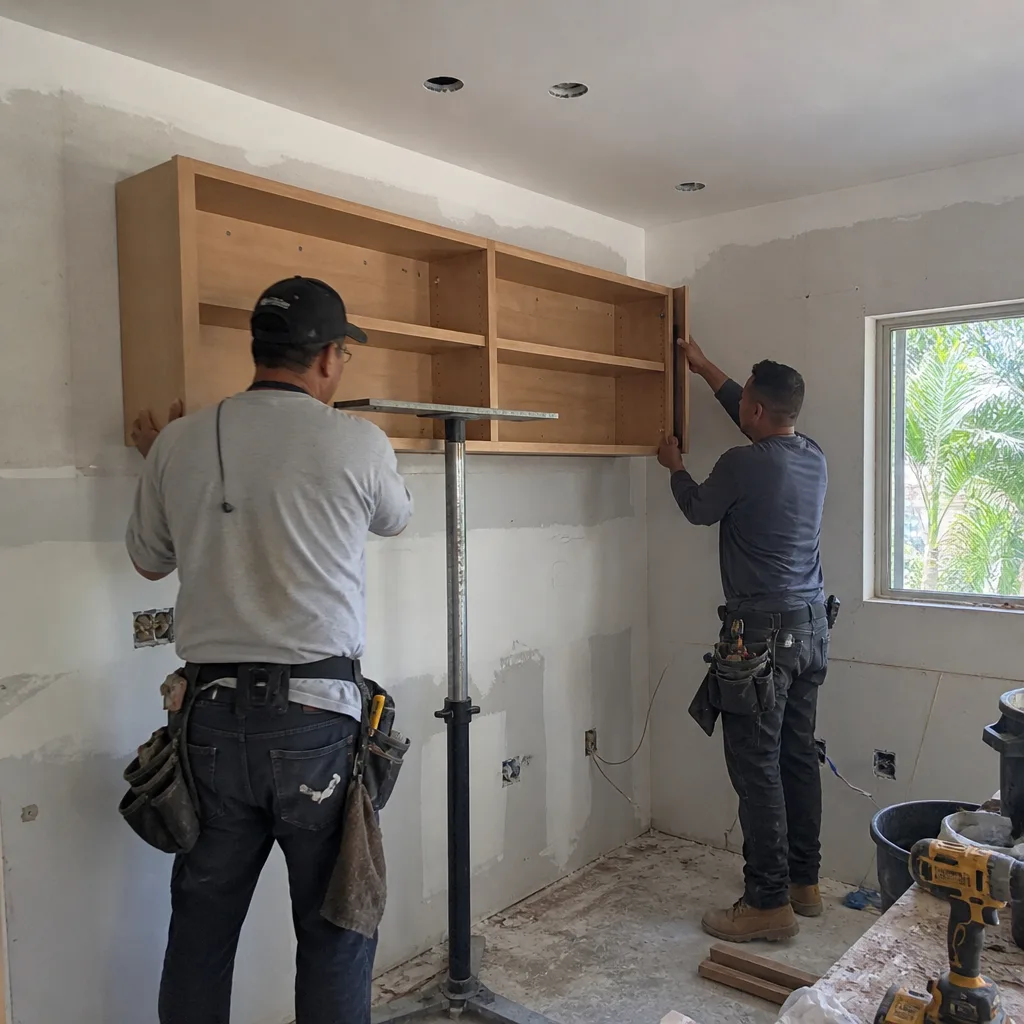
Key Takeaways
- Freestanding islands: $1,500-$5,000. Hardwired only: $4,000-$9,000. Full plumbed-and-wired: $8,000-$18,000+.
- In Miami’s older concrete-block and CBS homes, a sink in the island means cutting a slab core and pulling a plumbing permit with inspection.
- Unpermitted utility work becomes a documented deficiency at 40-Year Recertification. The liability lands on you, not the contractor who skipped it.
- The $1,000-off and 0% financing for 18 months offers apply to island projects, which turns a $12,000 plumbed island into $11,000 at roughly $611 a month interest-free.
Why a freestanding island and a plumbed island are two different budgets
A freestanding island is a furniture project. You level it, anchor it, build the countertop on top, and you’re done. That’s where the $1,500-$5,000 range comes from, and for a lot of Miami kitchens it’s the right call.
The minute you want a prep sink, a dishwasher, or a cooktop in that island, you’re doing construction. Water has to travel from the existing rough-in to the new location. Power has to come from a circuit that can actually carry the load. In a home where the kitchen sits over a slab, that means cutting concrete, running pipe and conduit, and pouring the slab back. In a 1960s Coral Gables CBS house, that sequence adds $3,000-$8,000 to the freestanding price once you account for Miami-Dade’s slab-penetration rules and the inspector who has to sign off before the concrete goes back.
None of that is padding. It’s the honest shape of the work, and it’s the reason two bids for the “same” island can differ by five figures. Here’s how the tiers actually break down on jobs we’ve scoped across Miami:
Kitchen island installation cost in Miami, by tier
| Island Type | What’s Included | Typical Miami Cost |
|---|---|---|
| Freestanding / no utilities | Cabinetry, countertop, anchoring, no plumbing or electrical | $1,500-$5,000 |
| Hardwired only | Electrical for outlets or a cooktop, no water or drain | $4,000-$9,000 |
| Full plumbed and wired | Sink, dishwasher, electrical, slab cutting, inspections | $8,000-$18,000+ |
| Full kitchen island installation (market range) | Complete island scope as quoted in Miami | $3,540-$11,800 |
Those tier numbers reflect licensed trade labor in a high-cost-of-living market, not the national averages you’ll find on most cost guides. Electrical and plumbing in Miami-Dade run on licensed trades, and the permit and inspection line items are real money. When we quote an island, the number you see is the number you pay. No allowance games, no surprise change orders once the slab is open.
The slab-core reality in Miami’s pre-1980 homes
Miami’s housing stock makes this a bigger deal than it is in most cities. A dense band of pre-1970s concrete-block and CBS homes runs through neighborhoods like Coral Gables, Shenandoah, and Little Havana, and much of that older stock was built on slabs with plumbing roughed in exactly where the original kitchen wanted it. Nowhere else, it turns out.
Move a sink two feet into a new island and you’re cutting a channel in that slab. That work generally requires a plumbing permit and an inspection, and in many Dade County jurisdictions it also calls for a structural consultation before you touch the concrete. The inspector shows up before the pour goes back in. Skip that sequence and you’ve bought yourself a cheaper invoice and a much larger problem later.
An island is a small part of a bigger project, and the same permit-and-inspection logic runs through the entire room. If you’re weighing an island against a full reconfiguration, our guide to Kitchen Remodeling in Miami covers where the big-ticket structural surprises tend to hide.
The 40-Year Recertification connection most contractors won’t mention
Miami-Dade requires buildings at 40 years old (25 near the coast) to pass a structural and electrical safety inspection. That cycle creates a predictable wave of concrete restoration, balcony and spall repair, and re-roofing work by neighborhood age, and it’s also where unpermitted kitchen work gets found out.
If a previous owner dropped a sink into an island without pulling a permit, that unpermitted plumbing and electrical shows up as a documented deficiency when the inspector walks the building. The liability for correcting it falls on you as the current owner, not on whoever cut the corner. We see this pattern often enough in older Miami homes that we build the permitting and inspection into the island scope from the start, not as an afterthought once the countertop is glued down. From foundation to finish line, the paperwork is part of the job.
Countertop choice: why Cambria quartz holds up in coastal kitchens
The countertop is the part of the island you actually touch, and in Miami’s subtropical climate it’s also the part the air works on. Salt-laden coastal air and year-round humidity swings push granite through a constant cycle of staining and resealing. Cambria quartz is the countertop we steer island projects toward: non-porous, UV-stable, and unaffected by the seasonal humidity that has homeowners resealing granite year after year.
Pair it with a home that gets used hard, and the right hardware matters too. We specify Moen and Delta fixtures on island sinks often, because a fixture that fails two years in costs more than the upgrade would have. Premium materials tied to a 730-Day Done Right Promise is the whole point: built to last, backed in writing.
If the island is part of a larger cabinet and countertop overhaul, it pays to price the pieces separately. Our pages on cabinet installation and countertop installation break out those line items so you can see exactly where the island’s dollars land.
What the $1,000 off and 0% financing actually mean for an island
Run the promotion against a real island project and it stops sounding like marketing. A $12,000 plumbed island, with the $1,000 off projects over $10,000 offer applied, comes to $11,000. Financed at 0% for 18 months, that’s about $611 a month interest-free. For a homeowner planning a meaningful kitchen upgrade, that’s the difference between deferring the project another year and getting the island this season.
The financing applies across our trades, so if the island is riding along with a roof or a set of impact windows, the same terms hold. Concrete numbers beat vague “affordable” language every time, and that’s the pricing philosophy across every project we quote.
Questions Miami homeowners ask before they commit
How much does kitchen island installation cost in Miami?
Kitchen island installation in Miami typically runs $3,540 to $11,800, with freestanding islands at the low end and plumbed-and-wired islands at $8,000-$18,000+ once slab cutting, permits, and inspections are included. The single biggest swing factor is whether you’re bringing water and power to the island. Call (833) 968-1198 for an exact quote. Estimates are free.
Do I need a permit to plumb a sink into a kitchen island in Miami-Dade?
Yes. Moving plumbing to an island requires a plumbing permit and an inspection, and in many Dade County jurisdictions a structural consultation before you cut the slab. The inspection happens before the concrete is poured back. Skipping it turns a routine renovation into a documented deficiency at 40-Year Recertification, and the liability lands on the homeowner. Call (833) 968-1198 and we’ll map out the permitting for your address.
Is it cheaper to repair and refit an existing island or install a new one?
Refitting usually wins if the existing island is already plumbed and wired and the layout works. If you’re adding a sink or a cooktop where there isn’t one, the slab and permit costs push you toward a new install anyway. The right answer depends on the rough-in behind your current island. Call (833) 968-1198 for a free estimate and we’ll tell you which path makes financial sense.
Can you install a kitchen island in Miami the same day?
A freestanding, no-utility island can sometimes be set in a single visit. A plumbed-and-wired island is a multi-stage job because the slab has to be cut, the plumbing roughed in, inspected, and poured back before the cabinetry and countertop go down. We sequence the inspections so nothing stalls waiting on a callback. Call (833) 968-1198 and we’ll lay out a realistic timeline for your kitchen.
Ready to price your island?
Every island starts with a free estimate and design consult, and a live person answers your call 24/7. We’ll measure the space, confirm what’s under the slab, and give you an upfront number with the permits and inspections built in. Groundwork Construction Co. of Miami backs the work with a 730-Day Done Right Promise, background-checked and uniformed technicians on every job, and financing that takes the sting out of a plumbed island. Call (833) 968-1198 today.
Written by the team at Groundwork Construction Co. of Miami, serving Miami, FL.
What Our Customers Say
"The schedule he gave me at the start was accurate to within four days on a three month job. Anyone who has done a renovation knows how unusual that is."
- Laura Bennett"He pulled the permits himself, scheduled every sub and ran the inspections. I made one decision a week and otherwise stayed out of it, which is exactly what I was paying for."
- Robert Sullivan"He told me one part of what I wanted was a bad idea structurally and offered an alternative instead of just taking the money."
- Angela Wong