
 Kitchen remodeling
 Bathroom remodeling
 Home additions & ADU
 Roofing
 Windows & doors
 Driveway & pavers
 Fence
Free written scope consultation - allowances, timeline, and change-order rules on paper before a single trade is scheduled
Styles & brands we work with
- Kitchen remodeling
- Bathroom remodeling
- Home additions & ADU
- Roofing
- Windows & doors
- Driveway & pavers
- Fence
See the difference
 Before
 After
 Before
 After
 Before
 After
Signs You Need a New Roof in Miami, FL: Start With the Year Your Building Was Built
The most reliable sign you need a new roof in Miami isn’t a stain on the ceiling. It’s the year your building went up. Miami-Dade requires a structural and electrical recertification inspection at the 40-year mark, and at 25 years for buildings near the coast, and the roof gets evaluated whether you booked anything or not. If your home is sliding toward that deadline, a roof that “looks fine” from the street can still trigger a Notice of Violation that forces replacement on a legal clock. Call (833) 968-1198 and we’ll help you figure out where you actually stand before the county does it for you.
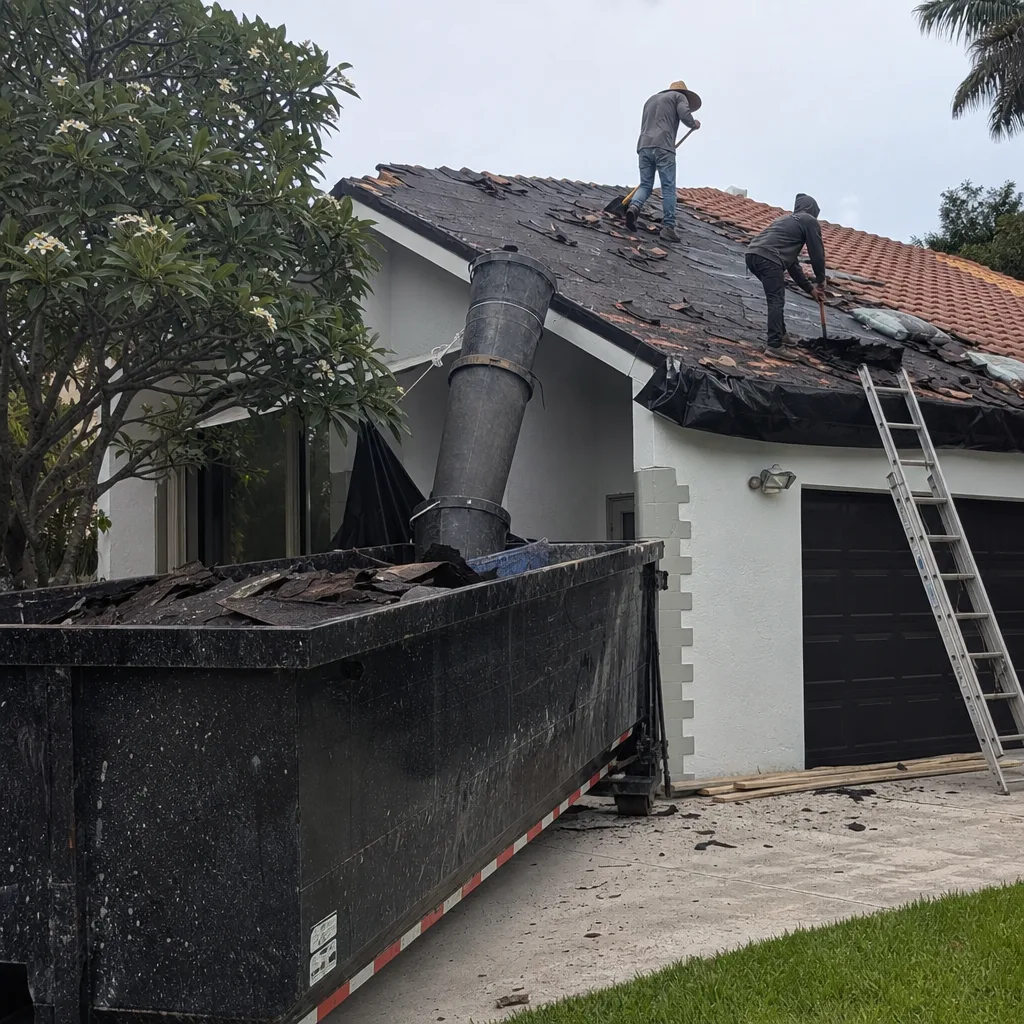
That’s the short version, and it’s the one most homeowners here learn the hard way. Miami’s climate, coastal air, and hurricane-season building codes make roof failure a different animal than it is in most of the country. Below is what actually signals a roof is finished, in the order we typically see it on Miami properties.
What to Look For: A Comparison Beyond the Obvious
Ask ten homeowners what makes them think the roof is done, and eight will say a brown ring on the drywall. That ring is real, but by the time you see it, water has already been traveling. Miami’s year-round humidity means moisture intrusion spreads sideways through insulation and framing long before it drops through the ceiling. Here’s how the signals stack up by how early they surface:
- The recertification deadline. Earliest and most serious. Miami-Dade’s 40-year inspection (25-year near the water) scrutinizes roofing systems directly. Spalling fascia, deteriorated underlayment, and flashings that don’t meet current code all show up in the report.
- Granule deposits in the gutters. Heavy shingle grit washing down is often the first physical clue coastal homes get, months before the mat shows from below.
- Blistering on flat and low-slope roofs. A bubble on a built-up roof is a delaminated membrane, not a cosmetic wrinkle. One storm can turn it into a full penetration.
- Interior condensation, musty attic air, or mold at the ceiling edges. In a subtropical climate these are roof-system symptoms, not just “a humid week.”
- Visible leaks and ceiling stains. Last on the list for a reason. This is the stage where you’ve already lost the head start.
Notice the order. The staging costs you time or money depending on where you catch it, and the recertification clock outranks everything else because it doesn’t wait for a leak.
The 40-Year Recertification Rule: Miami’s Quiet Roof Inspection
Here’s what most articles on roof warnings skip. In Miami-Dade, aging buildings must go through a county-mandated inspection, and the roof is right in the crosshairs. You aren’t choosing to have the roof assessed. The process does it for you.
When a roofer in Miami walks a building that’s been through recertification season, the failures cluster in predictable places: fascia that’s spalled from salt air, underlayment that’s baked through after a decade and a half of intense UV, and flashings installed to a code that has since moved on. Any of these can produce a Notice of Violation, and that notice turns “we should re-roof eventually” into “we re-roof by this date.”
The housing stock makes this sharper. Miami’s older neighborhoods are dense with pre-1970s concrete-block and CBS homes, many with flat or low-slope roofs and unreinforced masonry walls. Re-roofing one of these routinely pulls in wind-mitigation and structural upgrades at the same time. That’s why so much of the re-roofing work in this city moves in waves by building age rather than by storm damage.
And it says nothing about wind-resistance documentation. Miami-Dade County runs the only product-approval system of its kind in the country: every roof, window, and shutter needs a Miami-Dade NOA number, not just a Florida or national approval. We build to that standard on every job, using materials from partners like GAF and CertainTeed that carry the right approvals. If you want the full picture of how we scope a replacement, our Roofing page covers it.
Salt Air and UV: Why Miami Roofs Age Faster Than Their Warranty
A shingle rated for 25 years doesn’t get 25 years on the coast. Salt-laden air and relentless sun accelerate granule loss dramatically, and we regularly see coastal roofs with bare mat exposed in 12 to 15 years. The tell isn’t up top. It’s the pile of grit at the bottom of the downspout after a heavy rain.
Flat roofs take it harder still. Miami’s pre-1970s CBS homes with built-up flat roofs blister and alligator faster than pitched roofs under the same sun, because there’s no pitch to shed the UV load and no drainage to pull heat away. A blister is a membrane that’s already letting go. Treat it like an open wound before hurricane season, not after.
Wet-season timing matters too. June through November brings the storms that find every weak seam, and flood-zone (VE/AE) elevation rules and impact-glass requirements come into play for anything touching the building envelope. Roof sealing, underlayment, and exterior finishes all degrade fast here. That’s why the honest advice on a Miami roof is to inspect in the dry months and repair before the season turns.
When to Call: Same-Day Answers, Even on a Sunday
Roof problems don’t schedule themselves for business hours. A homeowner standing in a Sunday afternoon rainstorm watching water track across the ceiling needs an answer, not a web form that waits until Tuesday. Groundwork Construction Co. of Miami answers calls with a live person 24/7, so you can reach a real human the moment you notice something. We send background-checked technicians in uniform, and we lead with a simple question: is this a repair or a replacement? Many of these calls turn out to be a targeted repair, and we’ll tell you so.
What does a roof actually cost in Miami? Straight-up ranges, no sales theater:
| Service | Typical Miami Range |
|---|---|
| Roof Replacement | $9,440-$23,600 |
| Roof Repair | $470-$2,125 |
| Metal Roof Installation | $17,700-$47,200 |
| Tile Roof Repair | $710-$2,950 |
Every project is backed by our 730-Day Done Right Promise. If it isn’t done right, we make it right. Upfront pricing means the number you see is the number you pay, and 0% financing for 18 months plus $1,000 off projects over $10,000 makes a full replacement feasible without draining savings.
Frequently Asked Questions
If the damage is a single flashing, a few cracked tiles, or an isolated leak, a repair usually resolves it, often in the $470-$2,125 range. A roof needs replacing when the failure is systemic: widespread granule loss, blistering across a flat membrane, or recertification findings that flag the whole system. A walk-through settles it. Call (833) 968-1198 and we’ll give you a straight answer, free.
A roof replacement in Miami typically runs $9,440-$23,600, with metal roofs at $17,700-$47,200 and targeted repairs at $470-$2,125. The final number depends on square footage, roof type, and whether recertification forces wind-mitigation upgrades. Get an upfront quote with no surprises by calling (833) 968-1198.
Yes. Miami-Dade’s structural and electrical inspection at the 40-year mark (25 years near the coast) evaluates the roofing system, and findings like spalling fascia, failed underlayment, or non-compliant flashings can generate a Notice of Violation with a legal deadline. You don’t get to defer it. Call us early and we’ll help you plan the work before it’s on the county’s clock: (833) 968-1198.
Always. A live person answers our line 24/7, so a Sunday storm or a holiday leak gets a real human instead of a voicemail. That’s the whole point of the commitment. Reach us anytime at (833) 968-1198 for a free estimate.
Get Ahead of the Clock
If you’d rather have someone look at it than guess, Groundwork Construction Co. of Miami offers a no-pressure roof assessment across Miami. We’ll check the age against the recertification window, the gutters for granule loss, and the seams before the season turns. Call (833) 968-1198 for a free estimate and an honest read on repair versus replace.
Written by the team at Groundwork Construction Co. of Miami, serving Miami, FL.