
 Kitchen remodeling
 Bathroom remodeling
 Home additions & ADU
 Roofing
 Windows & doors
 Driveway & pavers
 Fence
Free written scope consultation - allowances, timeline, and change-order rules on paper before a single trade is scheduled
Styles & brands we work with
- Kitchen remodeling
- Bathroom remodeling
- Home additions & ADU
- Roofing
- Windows & doors
- Driveway & pavers
- Fence
See the difference
 Before
 After
 Before
 After
 Before
 After
Repair or Replace Your Roof in Miami? Start With the NOA Status, Not the Shingles
Replace, not repair, if your existing roof system no longer carries a valid Miami-Dade NOA approval – because in Miami-Dade, repair won’t get you back to code compliance once the system’s approval has lapsed, been superseded, or been compromised by mismatched tiles and non-approved flashing. Repair is usually the right call only when the system’s approval is intact and the damage is isolated. Everything else in the decision comes second. Call (833) 968-1198 and we’ll check your NOA status before we quote either path.
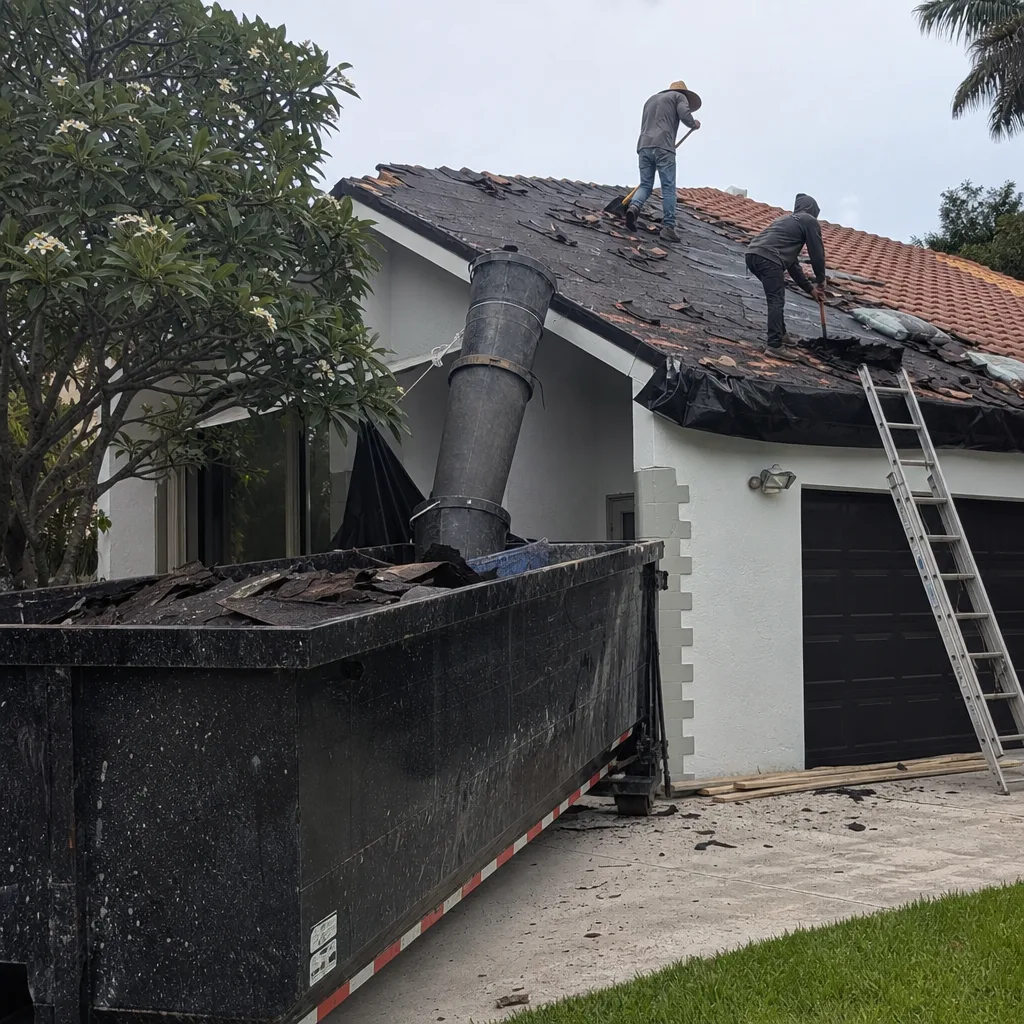
That tiebreaker is the part most repair-vs-replace advice skips, and it’s specific to Miami. Miami-Dade is the only county in the country with its own product-approval system. Every roofing component here has to carry a Miami-Dade NOA number – not just a Florida approval, not a national one. When a roof ages, gets patched by three different crews over fifteen years, or has its flashing swapped for whatever was on the shelf, the original approval can quietly stop applying to what’s actually on your house. Then a repair permit pulls an HVHZ inspection that fails on a system you never touched.
Why the Decision Looks Different in Miami Than Anywhere Else
Wind is the reason. The High Velocity Hurricane Zone governs how roofing gets permitted, inspected, and signed off across Miami-Dade, and the inspector isn’t evaluating your patch – they’re evaluating the whole assembly’s compliance. A repair that introduces a non-approved tile, underlayment, or fastener into an otherwise compliant system can trigger a requirement to bring the full field up to standard. We’ve watched homeowners authorize a $1,500 patch and end up facing a full re-roof because the original approval had already been superseded and nobody checked first.
So we check. Before we recommend anything, we verify the current NOA status of your existing system against the county database. That single step decides more repair-or-replace questions in Miami than moisture readings or age of shingles ever will.
There’s a second Miami variable worth naming: the 40-Year Recertification cycle. Buildings hitting the 40-year mark (25 years near the coast) go through a mandatory structural and electrical inspection. On a roof already showing moderate deterioration, a repair can become a stopgap the recertification inspection rejects two or three years later anyway. When we model it over a five-year horizon, replacing on the recertification timeline frequently costs less than repairing now and replacing on the county’s schedule.
How Miami’s climate speeds up the math
Salt-laden coastal air, year-round humidity, and intense subtropical sun break down underlayments, sealants, and exterior finishes faster here than in most of the country. On a flat roof – modified bitumen or built-up, common on the pre-1970s CBS homes across older Miami neighborhoods – patching more than 25% of the field surface is the threshold where replacement typically costs less per square foot than sequential patches. Disturb the surrounding membrane and the unpatched sections degrade faster, not slower. Repair budgets that made sense in year two don’t in year eight.
Repair vs. Replace in Miami: The Numbers Side by Side
We put both scopes in writing, line by line, so the comparison happens on paper instead of on a contractor’s verbal recommendation. A contractor who profits more from replacement will always steer you there; our job is to hand you the actual figures. Typical Miami ranges:
| Path | Typical Miami range | When it’s the right call |
|---|---|---|
| Roof repair | $470 - $2,125 | Intact NOA, isolated damage, no recertification exposure |
| Tile roof repair | $710 - $2,950 | Mismatched or cracked tiles, approved underlayment still good |
| Full roof replacement | $9,440 - $23,600 | Lapsed NOA, 25%+ flat roof patches, recertification window near |
| Metal roof installation | $17,700 - $47,200 | Replace-and-upgrade path on a long-horizon home |
Notice the gap. A repair runs a few hundred to a few thousand. A replacement runs roughly five to twenty times more. That gap is why repair looks obvious – and why it isn’t always. If the repair buys three years before the recertification forces replacement anyway, you’ve paid twice.
How financing changes the picture
The gap between “we can swing a repair” and “we can swing a replacement” closes more than most homeowners expect once financing enters. Our 0% financing for 18 months, paired with $1,000 off projects over $10,000, turns a $9,440 replacement into a monthly number you can actually weigh against a $2,000 repair – one that carries no two-year guarantee, one that may not survive its next inspection. And whatever you choose, the 730-Day Done Right Promise backs it: if it’s not done right, we make it right. That’s one of the longest workmanship guarantees in residential construction, and it applies to the repair scope too. A short repair with a real guarantee behind it beats a cheap patch with nothing – but a replacement financed at zero interest often wins on the math once you model the five-year total honestly. On material brands, we work with GAF and CertainTeed on roofing, and every proposal states exactly which system and which approval applies.
Common Repair-or-Replace Scenarios We See Across Miami
- A 1960s CBS home in a coastal neighborhood, original flat built-up roof, patched four times. Past the 25% threshold and approaching its 40-year window – we look hard at replacement timed to the recertification cycle.
- A 1990s concrete-block house with an intact tile system, a few cracked tiles after a storm. NOA still active, underlayment sound – repair, clearly.
- A Mediterranean Revival property with mismatched replacement tiles installed by a prior crew. The system no longer matches its approval; a repair permit risks a full-field requirement, so replacement is the legally defensible path.
- A condo-adjacent home with impact-rated components elsewhere but flashing replaced with non-approved material. Wind-mitigation compliance becomes part of the conversation, and we check the NOA before touching the repair.
Each of these plays out differently depending on age, neighborhood, and what the county database says about the system. That’s why we don’t quote blind. If you’re mapping a larger project alongside the roof, our Roofing service page covers the full scope, and you can see what else we handle across our Miami service area.
What to Check Before You Decide
You don’t have to diagnose this yourself, but you should know what a real assessment includes so no one shortcuts it:
- The current NOA status of your existing system in the county database – active, superseded, or lapsed.
- Whether prior repairs used approved components. Mismatched tiles and off-spec flashing are the usual culprits.
- Total field surface already patched, especially on flat roofs – the 25% line matters.
- Proximity to your 40-year (or coastal 25-year) recertification date.
- Both scopes in writing, with materials and approvals named.
Roof work in the HVHZ is not a safe DIY category – it’s fall exposure, wind-rated assemblies, and inspection compliance rolled into one. That’s a job for a trained, permitted crew, not a weekend project.
FAQs
Often no. If the existing system’s Miami-Dade NOA is no longer active or the repair introduces non-approved material, the inspector can require the full field brought up to standard, not just the repaired section. That’s why we check NOA status first – call (833) 968-1198 and we’ll confirm yours before recommending anything.
Roof replacement in Miami typically runs $9,440 to $23,600, while a repair usually lands between $470 and $2,125, and tile roof repair between $710 and $2,950. Metal roof installation, if you’re upgrading, runs $17,700 to $47,200. Call (833) 968-1198 for a written quote – estimates are free.
Sometimes, yes – and that’s the case for timing replacement to the recertification cycle now rather than patching and paying twice. If your building is near its 40-year (or coastal 25-year) mark and the roof shows moderate wear, a repair may not survive the mandatory inspection. Call (833) 968-1198 to model the five-year numbers.
Replace, once patching exceeds about 25% of the field surface. Past that threshold, replacement usually costs less per square foot than sequential patches, and Miami’s sun and rain degrade the unpatched sections faster once the surrounding membrane is disturbed. Call (833) 968-1198 for a side-by-side comparison.
If you’d rather have it looked at, Groundwork Construction Co. of Miami offers a no-pressure assessment in Miami – we verify your NOA status, put repair and replacement scopes in writing, and let the numbers decide. Call (833) 968-1198 for a free estimate.
Written by the team at Groundwork Construction Co. of Miami, serving Miami, FL.