
 Kitchen remodeling
 Bathroom remodeling
 Home additions & ADU
 Roofing
 Windows & doors
 Driveway & pavers
 Fence
Free written scope consultation - allowances, timeline, and change-order rules on paper before a single trade is scheduled
Styles & brands we work with
- Kitchen remodeling
- Bathroom remodeling
- Home additions & ADU
- Roofing
- Windows & doors
- Driveway & pavers
- Fence
See the difference
 Before
 After
 Before
 After
 Before
 After
What ADU Construction Costs Per Square Foot in Miami, FL
ADU construction in Miami runs $53,100 to $153,400 for a typical project, and cost per square foot lands well above the national $150-$300 average once you account for Miami-Dade’s High Velocity Hurricane Zone requirements. That national range assumes products off a standard shelf. Here, the shelf is shorter and every approved product costs more. Call (833) 968-1198 and we’ll walk you through real numbers for your lot before you commit to anything.
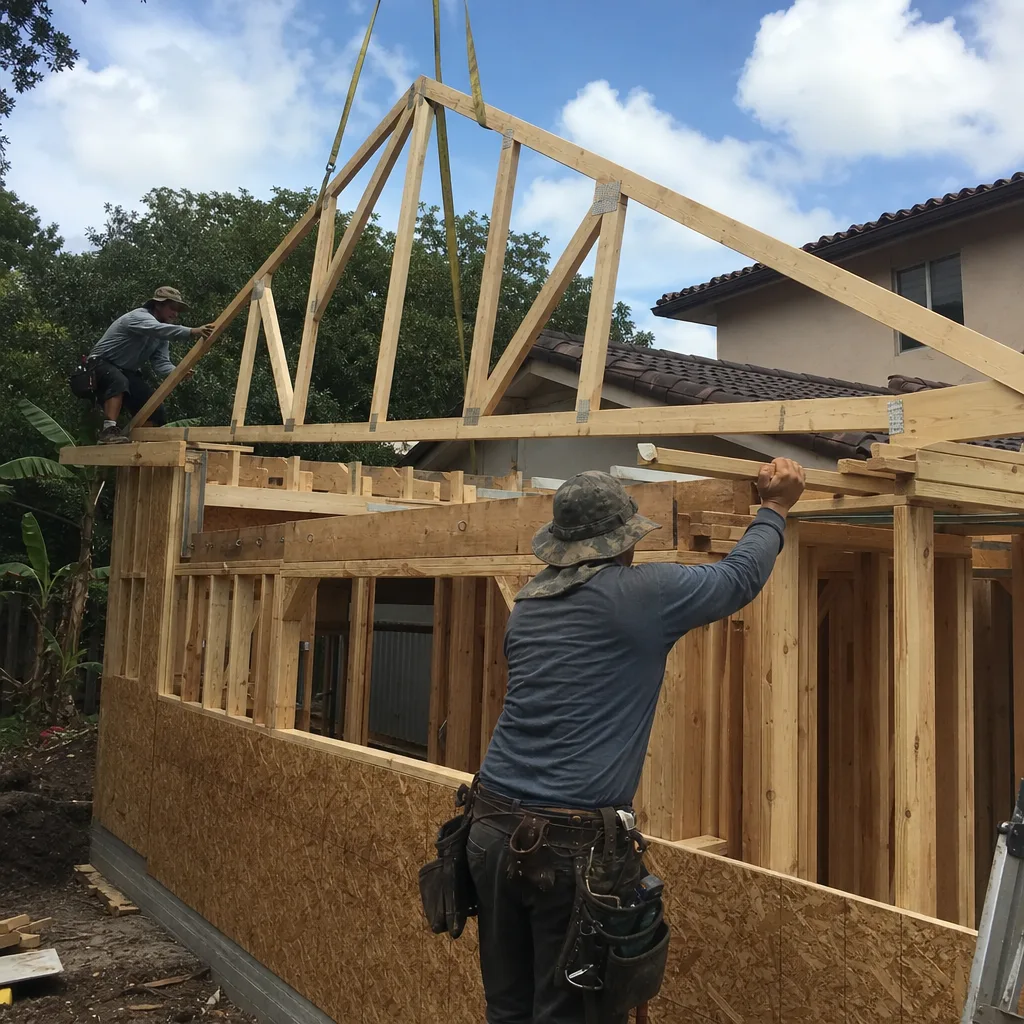
The reason is simple and it’s the thing most cost calculators on the internet leave out: Miami-Dade County is the only place in the US with its own product-approval system. Every roof, window, shutter, door, and fastener that touches the building envelope needs a Miami-Dade Notice of Acceptance, or NOA number. Not a Florida approval. Not a national one. A Miami-Dade NOA. That extra layer of certification is baked into your labor and materials before a single stud is set. Anyone quoting you a square-foot price without acknowledging it either doesn’t build here or is planning to cut a corner you’ll pay for at inspection.
Why Your Square-Foot Number Runs Higher Than the National Average
If you’ve been pricing ADUs against numbers from a site based in Texas or the Carolinas, expect sticker shock. Here’s the premium in plain terms.
Impact windows that carry a Miami-Dade NOA cost roughly 40-60% more than standard windows of the same size and profile. Approved roofing systems add another $1-$3 per square foot over non-HVHZ equivalents. A 700-square-foot detached ADU might use a dozen or more windows and a roof assembly sized to resist wind-borne debris in a Category 5 event. The math compounds fast. On a mid-size build, the NOA-driven premium alone can add $12,000-$28,000 over what the same plan would cost outside the HVHZ.
We source impact windows from Andersen and Marvin and roofing from GAF and CertainTeed. The point isn’t the logos. It’s that these manufacturers maintain Miami-Dade NOA documentation for the products we spec, so the approval work is already done. A contractor who doesn’t know the system has to shop for approvals in real time, and you’re paying for their learning curve in delays.
Cost Per Square Foot by ADU Type in Miami
Not every ADU is a new detached structure. The type you build drives the per-square-foot math, sometimes by a wide margin. Here’s how the three main categories break down in Miami.
| ADU Type | Typical Project Cost | What Drives the Spread |
|---|---|---|
| Detached new-construction ADU | $106,200-$259,600 | Full HVHZ envelope, new foundation, separate utility runs, impact windows and approved roof system |
| Garage conversion ADU | $35,400-$94,400 | Existing slab and walls reused; cost sits in insulation, impact openings, kitchen and bath rough-in |
| Interior JADU (within the home) | Below $35,400 in most cases | No new envelope; sharing HVAC and plumbing with the main house cuts per-square-foot cost most |
Detached builds carry the highest per-square-foot cost because everything is new: foundation, walls, roof, windows, and the mechanical, electrical, and plumbing that has to run from the main house. Garage conversions reuse the slab and the block walls, so you’re mostly paying for the envelope upgrades (the existing garage door opening gets framed out and filled with an NOA-compliant impact wall and door or window) plus the kitchen and bath. Interior JADUs share systems with the house and stay under the same roof, which is why they’re the cheapest path, though some Miami lots and existing homes simply won’t accommodate the layout.
The Foundation Variable Nobody Warns You About
Miami’s high water table and its flood-zone designations change the economics before framing starts. A lot in an AE flood zone often requires an elevated slab or stem-wall construction to meet floodplain elevation rules. Depending on the design, that alone adds $15-$30 per square foot before anyone picks up a nail gun. It’s not a hidden fee; it’s civil engineering tied to where your house sits. But if you haven’t accounted for it, the per-square-foot number you were working from is fiction.
We look at your lot’s flood designation early, during the design consult, so the foundation cost appears in your first real estimate rather than in a change order three weeks into the build. That early look is part of the free estimate and design consult we run for every Miami homeowner.
How Hidden Re-Work Costs More Than a Good Bid
Out-of-market or unlicensed contractors unfamiliar with Miami-Dade’s NOA system routinely install products that fail inspection. When the inspector rejects a non-compliant window or roof assembly, the product comes out and you start over: tear-out, disposal, replacement, re-inspection. That re-work can easily run into the tens of thousands and it happens on the homeowner’s dime. It’s one of the most common cost overruns we’re called in to clean up.
Groundwork Construction Co. of Miami works with background-checked, uniformed crews who know what carries a NOA and what doesn’t. That’s the practical value of local experience, and it’s what keeps your per-square-foot number from creeping upward after you’ve signed. Every project we build is covered by our 730-Day Done Right Promise, so if something isn’t right, we make it right in writing.
Building Well in Miami’s Heat, Salt, and Storm Season
Miami’s subtropical climate stresses a building envelope in ways that go beyond wind. Salt-laden coastal air, year-round humidity, and intense sun degrade sealants, underlayments, and exterior finishes faster than in most of the country. Wood framing faces severe termite pressure. Those aren’t reasons to skip building; they’re reasons to spec the right products the first time.
We plan your exterior finishes and detailing around what actually holds up here, so you’re not repainting sealants every few years. If you’re weighing a standalone ADU against an addition on the existing house, our guide to Home Additions & ADU breaks down how the two compare, including which fits different lot sizes and budgets. And if you’re still mapping the whole project scope, start with our home page to see the full range of what we build.
Ways to Bring the Affordable Version of Your Budget Into Reach
A detached ADU isn’t a small purchase, and we won’t pretend otherwise. What we do is make the number predictable and make it easier to finance. Upfront pricing means the number you see is the number you pay, and we pair it with 0% financing for 18 months plus $1,000 off projects over $10,000, so a large build doesn’t have to drain cash reserves in one hit. Calls are answered by a live person, 24/7, so you’re never waiting until Monday morning for a straight answer.
- Know the envelope cost first. Impact openings and approved roofing aren’t optional in the HVHZ, so plan for them in the base budget.
- Check your flood zone early. AE or VE lots may need an elevated slab, which changes the foundation line before framing.
- Pick your ADU type before you design. Detached, garage conversion, and JADU have very different per-square-foot math.
- Insist on NOA documentation. Ask to see it for every envelope product; it’s the difference between passing and re-work.
FAQs
Most Miami ADU builds land in the $53,100-$153,400 range depending on type and size, and per-square-foot cost runs above the national $150-$300 average because of HVHZ product requirements. Detached new builds sit near the top of the range; garage conversions and interior JADUs come in lower. Call (833) 968-1198 for an exact per-square-foot figure on your lot, free.
Miami-Dade is the only US county with its own product-approval system, so every window, roof, and shutter on your ADU must carry a Miami-Dade NOA number. NOA-approved impact windows run 40-60% more than standard windows, and approved roofing systems add $1-$3 per square foot. That premium compounds across a full build, which is why the local square-foot number is higher than the national one.
A garage conversion is almost always cheaper, typically $35,400-$94,400 versus $106,200-$259,600 for a detached build, because you reuse the existing slab and walls. The trade-off is that a conversion depends on your garage’s condition and whether the layout works for a kitchen and bath. We’ll tell you straight which fits your property during the free design consult. Call (833) 968-1198 to schedule one.
Timing depends on design, permits, and your lot’s flood designation, and we give you a realistic schedule upfront rather than an optimistic one. Securing NOA-compliant materials early is a big part of staying on schedule, and sourcing them is already part of how we work. Call (833) 968-1198 so we can look at your project and tell you what’s achievable.
Get a Real Per-Square-Foot Number for Your Miami ADU
Guessing at cost from national calculators wastes your time. Let us look at your lot, your flood zone, and your plans and put a real number in front of you. Free estimate, free design consult, upfront pricing with no surprises, and 0% financing for 18 months. Call (833) 968-1198 today and get your ADU build moving.
Written by the team at Groundwork Construction Co. of Miami, serving Miami, FL.
What Our Customers Say
"The schedule he gave me at the start was accurate to within four days on a three month job. Anyone who has done a renovation knows how unusual that is."
- Laura Bennett"He pulled the permits himself, scheduled every sub and ran the inspections. I made one decision a week and otherwise stayed out of it, which is exactly what I was paying for."
- Robert Sullivan"He told me one part of what I wanted was a bad idea structurally and offered an alternative instead of just taking the money."
- Angela Wong