
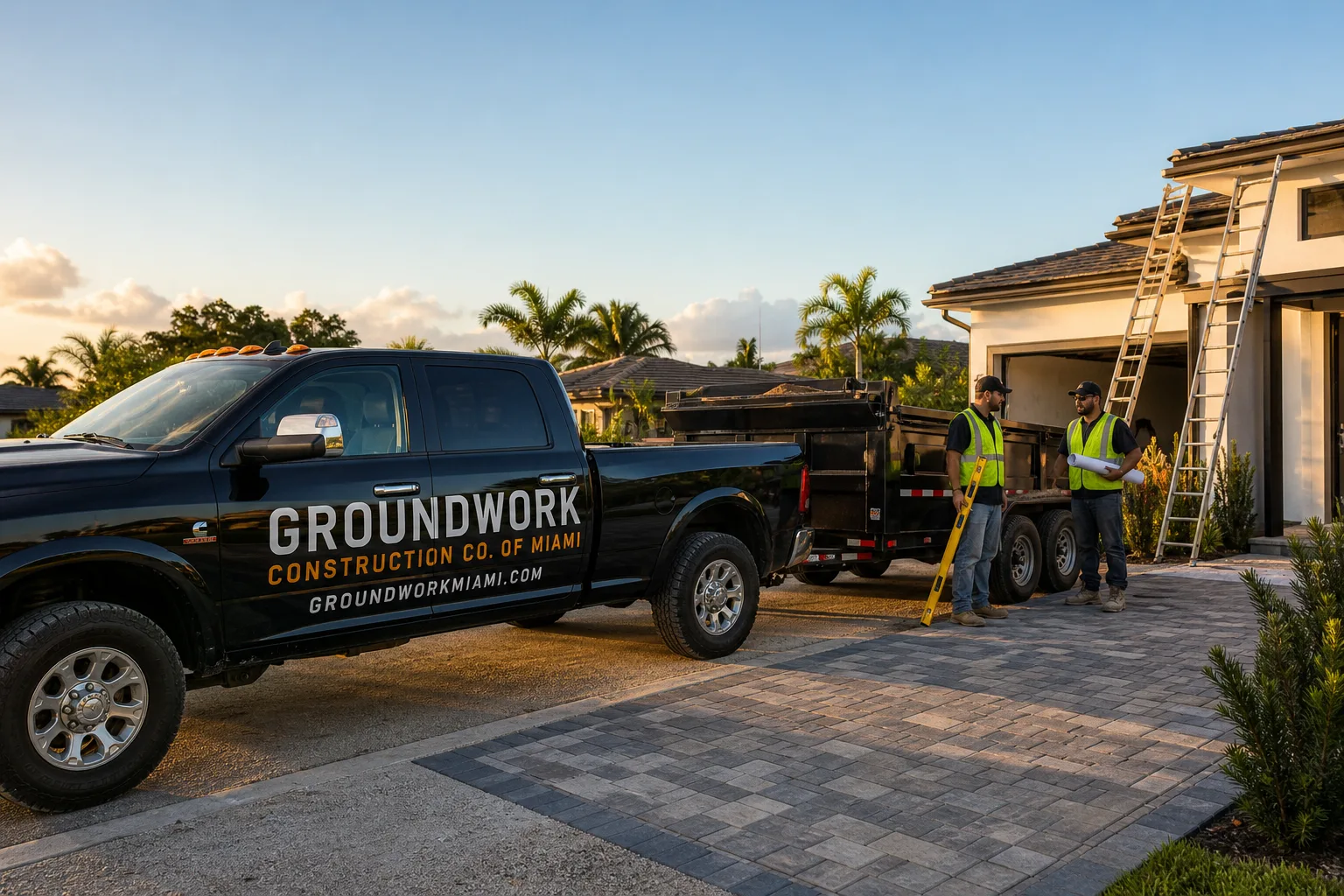
 Driveway & pavers
 Kitchen remodeling
 Bathroom remodeling
 Home additions & ADU
 Roofing
 Windows & doors
 Fence
Free written scope consultation - allowances, timeline, and change-order rules on paper before a single trade is scheduled
Asphalt Driveways & Resurfacing in Miami, FL
Asphalt Driveways & Resurfacing in Miami usually means one of two jobs: a fresh hot-mix asphalt pour for a new driveway, or a mill-and-overlay resurfacing that grinds off the worn top layer and lays down a new one. Most residential driveways here run two to three days on site, and typical pricing lands between $4,130 and $10,620 for paving, with resurfacing at the lower end and full replacement closer to $5,900 – $16,520. Call (833) 968-1198 and we’ll walk your driveway, measure it, and give you a written number.
How the resurfacing and paving work actually runs, stage by stage
An asphalt driveway isn’t a one-day dump-and-go. The sequence matters more than the material, especially in a subtropical climate with a hurricane season. Here’s what a real job looks like from our side of the clipboard.
Stage 1: Site walk and base inspection (day one, 45 – 90 minutes)
We start by probing the existing base. On a resurfacing, that means checking for soft spots, alligator cracking, and any sections that have settled. If more than roughly 20% of the surface is failing, patching won’t hold, and we’ll tell you that up front instead of burying it. On a new pour, we measure slope and drainage away from the garage slab, because in Miami water that sheets toward the house is the beginning of a bigger problem. You’ll decide at this stage whether you’re resurfacing or replacing.
Stage 2: Demolition, milling, or grading (day one to two)
For resurfacing, a milling machine grinds off the top inch or two of old asphalt so the new layer bonds to a clean surface. It’s loud, it’s dusty, and it takes most of a day on a standard two-car driveway. For a new build, we remove the old surface, grade the subgrade, and compact it. You’ll want your cars off the driveway for this whole stretch, not just the day of the pour.
Stage 3: Base repair and stone prep (day two)
Soft spots get dug out and backfilled with compacted stone. This is the stage most homeowners never see and the one that determines whether you’re calling someone again in three years. In Miami, where we get hard summer downpours, a properly compacted limerock or crushed-stone base is what keeps the driveway from rutting. You decide here whether to add a geotextile fabric layer if the soil is unstable, which runs a few hundred dollars more but pays for itself on sandy lots.
Stage 4: Paving or overlay (day two to three)
Hot-mix asphalt goes down at roughly 2 inches compacted for a residential overlay and 3 inches for a new driveway, laid in lifts and rolled while still hot. The crew has a limited window here, because asphalt cools fast and won’t compact properly once it does. If you’re adding a wider apron or a turnaround, you’ll want to have settled that at the estimate, not on pour day.
Stage 5: Cure and seal timing (30 days before the first seal)
Fresh asphalt needs about 30 days to cure before it’s sealed, and longer in Miami’s humid stretch. We schedule the seal coat as a separate visit rather than rolling it into the same week. You’ll get a written timeline for that second visit, and it’s covered under our 730-Day Done Right Promise like the rest of the job.
Styles & brands we work with
- Kitchen remodeling
- Bathroom remodeling
- Home additions & ADU
- Roofing
- Windows & doors
- Driveway & pavers
- Fence
The options you’ll choose between
Asphalt isn’t a single product. What you pick changes cost, lifespan, and how the driveway handles Miami sun and rain.
- Hot-mix vs. cold-patch: Hot-mix is the real thing, laid at temperature and compacted, and it’s what any driveway worth the money uses. Cold-patch is a temporary fix for potholes that won’t survive a Miami summer.
- Overlay vs. full replacement: An overlay resurfacing costs less and finishes faster, but only works if the base is sound. Full replacement is more expensive and the only honest answer when the subgrade has failed.
- Standard vs. polymer-modified asphalt: Polymer-modified mix resists rutting and sun damage better in our climate, at a modest premium. On a driveway in full afternoon sun, it’s usually worth it.
- Drainage options: A crowned driveway, a channel drain, or a French drain along the low side. Miami’s rain volume decides this more than aesthetics do.
- Edging and borders: Concrete curbing holds the asphalt edge and keeps it from crumbling. Pavers as an accent border are an option if you want the driveway to tie into a wider hardscape, which is where our Driveway & Pavers in Miami work usually comes in.
What Asphalt Driveways & Resurfacing costs in Miami, FL
Plan on $4,130 – $10,620 for asphalt paving in Miami, $5,900 – $16,520 for a full driveway replacement, and $295 – $825 for a seal coat. Resurfacing an existing driveway usually lands in the lower half of the paving range.
Five things push a job toward one end or the other:
- Square footage: A single-car driveway is a different job than a wide two-car with a turnaround. Size is the biggest single driver.
- Base condition: A sound base means a mill-and-overlay. Failed base means excavation, new stone, and full replacement.
- Access: A driveway a dump truck and roller can’t reach cleanly, or one hemmed in by a wall or mature tree canopy, slows the job and adds labor.
- Drainage work: Adding a channel drain or regrading to move water off the slab is priced separately from the asphalt itself.
- Permit scope: Work that changes the footprint, crosses a swale, or touches the right-of-way can trigger a permit and inspection, which we pull and manage.
Your written estimate is line-itemed: square footage, depth, base prep, drainage, permit if one is required, and the seal visit. What isn’t included is sod or landscaping restoration beyond the work zone, and any unexpected underground utility relocation. If we hit something the estimate didn’t anticipate, you’ll hear it before we spend a dollar on it.
See the difference
 Before
 After
 Before
 After
 Before
 After
What Miami homes specifically do to this job
Miami construction runs under the High Velocity Hurricane Zone, and Miami-Dade County is the only place in the US with its own product-approval system: the NOA number. That system governs roofs, windows, and shutters more than driveways, but the same culture of documented compliance shapes how work gets permitted here, and it’s why we pull permits when the scope calls for one instead of hand-waving it. Add the 40-Year Recertification law, and you get a city where older properties are under regular structural scrutiny.
The housing stock is what we see most: pre-1970s CBS concrete-block homes with flat or low-slope roofs, 1920s Mediterranean Revival and MiMo buildings, and the post-2000 glass towers along Brickell and Biscayne Boulevard. On the older masonry homes, driveways were often poured decades ago and have settled or cracked from root pressure and our sandy soil. In neighborhoods like Coconut Grove and Coral Way, we routinely find asphalt that was patched repeatedly rather than repaired, and the honest fix is a base rebuild, not another overlay. Salt-laden coastal air and intense sun break down asphalt binders faster here than inland, which is why a seal coat every two to three years isn’t optional in Miami.
Serving Miami, FL – Our Local Coverage Area
We serve Miami and nearby communities. Use the map below to see the area we cover. If you’re nearby, we can almost certainly help.
Frequently asked – Asphalt Driveways & Resurfacing in Miami
Most residential jobs take two to three days on site, plus a 30-day cure before the first seal coat. Rain is the main variable in Miami’s June – November hurricane season, since asphalt can’t be laid wet. We schedule around the forecast and give you a written timeline, and if weather pushes the job we’ll call you the same day.
A straight like-for-like resurfacing usually doesn’t require one, but a new footprint, a widened apron, or work in the right-of-way often does. We check against your property’s zoning and pull and manage the permit when it’s required, so the inspection passes the first time.
Yes, if the base is sound and less than about 20% of the surface is failing. A mill-and-overlay resurfacing grinds off the top layer and lays new asphalt over the intact base, which saves money and time. If the base has settled, an overlay will crack within a season, and we’ll tell you that before you spend on it.
Resurfacing reuses the existing base and replaces only the top layer, while replacement removes the old driveway and rebuilds from the subgrade up. Replacement costs more but is the only durable fix when the base has failed. We quote both when there’s a genuine choice, so you can see the trade-off in writing.
Asphalt paving runs $4,130 – $10,620, replacement $5,900 – $16,520, and sealing $295 – $825. Every job is backed by our 730-Day Done Right Promise, and the number on your written estimate is the number you pay. Call (833) 968-1198 for an exact quote, with free estimates and 0% financing for 18 months available.
Get a free estimate on your Miami asphalt driveway
Tell us the address and what’s happening with the surface, and we’ll walk it with you, measure it, and hand you a written line-item estimate at no charge. If you’re planning a wider project, this work often pairs with a New Detached ADU in Miami or a Junior ADU & Interior Conversion in Miami that adds a second access point off the driveway. We cover all of Miami and nearby areas like Coral Gables, Coral Terrace, and Miami Springs through our Driveway & Pavers service. Call (833) 968-1198 to schedule your free estimate.
Written by the team at Groundwork Construction Co.