
 Fence
 Kitchen remodeling
 Bathroom remodeling
 Home additions & ADU
 Roofing
 Windows & doors
 Driveway & pavers
Free written scope consultation - allowances, timeline, and change-order rules on paper before a single trade is scheduled
Styles & brands we work with
- Kitchen remodeling
- Bathroom remodeling
- Home additions & ADU
- Roofing
- Windows & doors
- Driveway & pavers
- Fence
See the difference
 Before
 After
 Before
 After
 Before
 After
How to Repair a Chain Link Fence in Miami, FL: Diagnose the Failure Before You Patch It
The short answer: find what’s actually failing first. On most Miami chain link fences, a sagging run or a wobbly post is a symptom, not the problem. The real culprits are usually galvanized coating breakdown from salt-air oxidation, tension wire failure on long runs, or footing damage from tree roots pushing against post concrete. Patch the symptom and it comes back inside a year. Diagnose the cause and the repair holds. Here’s how we walk through it at Groundwork Construction Co. of Miami before recommending patch, reconfigure, or replace. Call (833) 968-1198 if you’d rather have someone look at it in person.
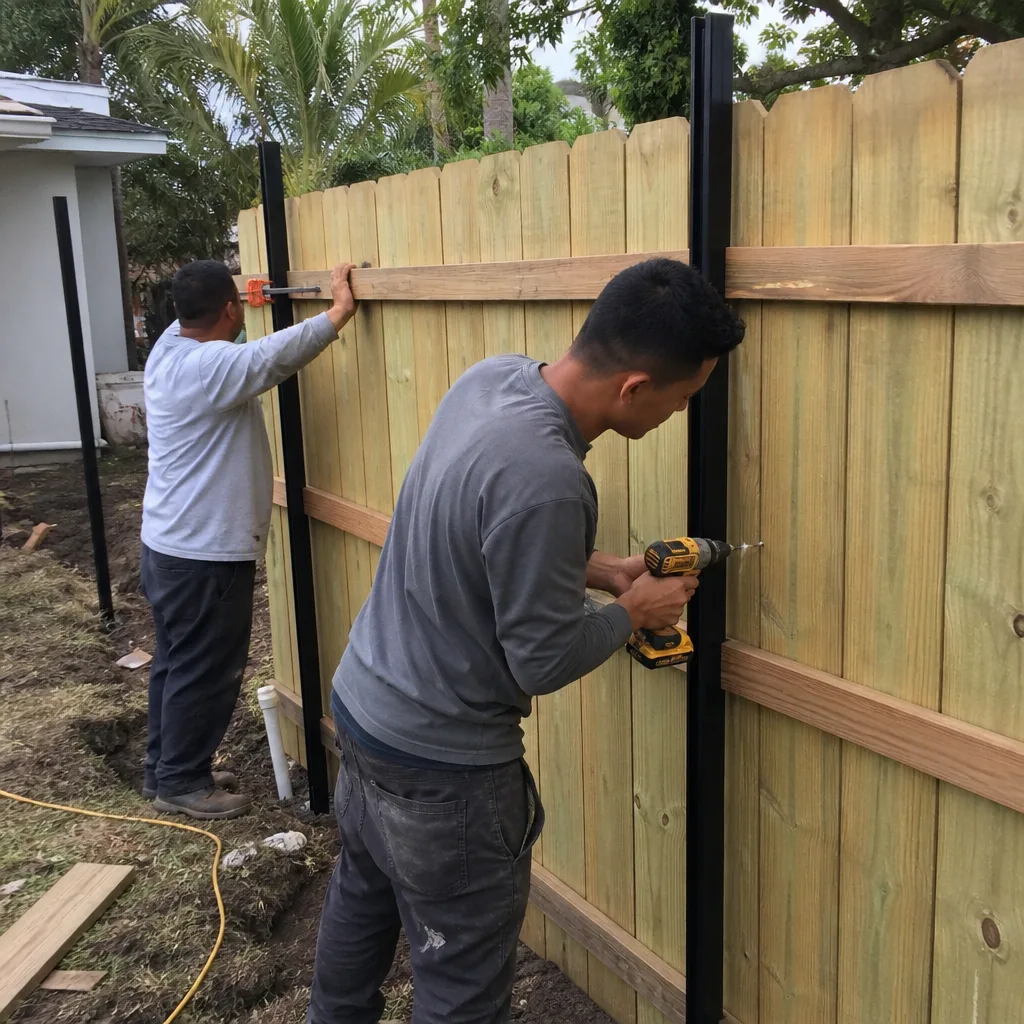
Why Chain Link Fails Differently in Miami Than Anywhere Else
Chain link in a Homestead backyard can look fine from 10 feet away. Get close to the bottom rail, though, and if the galvanized coating has gone chalky white with that zinc oxide bloom, you’re two hurricane seasons from a rust-through failure right at grade. That’s the pattern we see over and over. Miami’s salt-laden coastal air attacks galvanized steel from the outside in, and it always starts at the lowest point of the fence first, where rain splashes and ground moisture keep the coating wet the longest.
It’s not just the coast. Year-round humidity and the June-through-November storm season put chain link through more cycles of wet-and-dry than most of the country sees in a decade. On top of that, Miami-Dade sits inside the High Velocity Hurricane Zone, the only county in the US with its own product-approval system. Every exterior assembly here is judged on documented wind resistance, and a fence is no exception. A repair that ignores wind loading is a repair you’ll redo.
The Three Miami Failure Modes, in Order of Frequency
- Galvanized rail and post corrosion from salt-air oxidation. Most common near the coast and on any fence where the bottom rail sits close to irrigated turf. Chalky white bloom, then brown rust, then structural loss at grade.
- Mesh sag from tension wire failure on long runs. Common on long property lines in Hialeah and along the Miami Gardens industrial corridors. The mesh depends on the tension wire and top rail to hold its shape; when the wire slackens or the ties give way, the whole run sags between posts.
- Post footing heave from root pressure. Older Coral Gables and South Miami neighborhoods with mature Royal Palms and Ficus trees see this constantly. Roots push against the concrete footing, the post leans, and the fence line goes out of plane.
Order matters. Fix the footing before you touch the mesh, or you’ll tension a run against a post that’s still moving.
Repair or Replace the Post? A Screwdriver Tells You in Ten Seconds
Surface rust on a chain link post is cosmetic. Wire-brush it to bare metal, treat it, and cold-galvanize it, and the post keeps doing its job. The question is how much steel is left.
Our technicians run a screwdriver push test right at grade, where corrosion concentrates. Light surface pitting and the post is a candidate for treatment. But a post that’s lost more than about 20% of its wall thickness at grade is structurally compromised. No coating saves it. Push a screwdriver through it and it has to come out, concrete bell and all. We’ve seen plenty of fences where a homeowner wanted a quick patch and the honest answer was two new posts and a re-set corner. Better to know that before the work starts than after.
If you’re leaning toward replacement rather than repair, our Fence Installation in Miami page covers material options and the wind-rated specs we build to. For the broader picture on how we approach fences across the region, the main Fence Installation page is a good starting point.
The Mesh Gauge Reality for Miami Wind Conditions
Standard residential chain link uses 11-gauge mesh. On a calm-inland lot that’s fine. But if your property sits inside Miami-Dade’s HVHZ, patching a section with matching 11-gauge is the cheapest repair, not the strongest one. The wind-resistant repair is upgrading that section to 9-gauge mesh with a top rail brace. Thicker wire and a braced rail handle pressure that a simple cut-and-splice of matching light material won’t.
This is where a lot of guides fall short. They explain how to splice matching mesh, which is correct for a cosmetic repair, but they don’t account for what a Miami fence actually faces. If the fence protects a pool, a dog run, or a property line you care about, put the stronger gauge in.
Tension Wire Re-Threading, Step by Step
- Inspect the terminal posts first. Make sure the corner and end posts are solid. In Miami, terminal posts are typically set in 36-inch deep concrete bells. You’re tensioning against a fixed anchor, not a loose post, and that’s the whole reason the process works.
- Release the old tension wire at the turnbuckle or tension bar and pull it free of the mesh. Check for kinks; a kinked wire won’t tension evenly.
- Thread the new wire through the bottom of the mesh along the run, keeping it above the rails or at the bottom of the fabric per your setup.
- Attach it to the terminal posts with tension bars, then work the turnbuckle or stretcher slowly along the run.
- Tension gradually. Here’s the Miami-specific warning: over-tensioning can crack aging concrete footings on pre-1980s fence installations. Older bells are brittle. Pull until the mesh is taut and flat, not until the wire sings.
- Re-tie the mesh to the top rail and re-hang any gates so they swing without dragging.
The tensioning step is the one to be careful with. A footing that gives way under too much pull turns a mesh repair into a full post replacement.
What Chain Link Repair Costs in Miami
Chain link fence repair in Miami typically runs $4,130 to $10,620 depending on how much of the fence is failing and whether posts come out. A single-section mesh patch sits at the low end. A run that needs new posts set in fresh concrete bells, upgraded 9-gauge mesh, and re-tensioned corners moves toward the top. These are the market-calibrated ranges we work from, and we quote them upfront, no surprises.
| Repair scope | Typical Miami range |
|---|---|
| Chain link fence repair (full scope, this page) | $4,130 - $10,620 |
| Vinyl fence installation (comparison) | $4,130 - $10,620 |
| Aluminum fence installation (comparison) | $4,720 - $11,800 |
If you’re comparing a repair against a fresh install, those vinyl and aluminum figures come courtesy of partners like Bufftech and ActiveYards, whose systems we install. When the repair is a patch on an aging fence, sometimes the numbers make the case on their own.
Every job we do is covered by the 730-Day Done Right Promise. If a re-tensioned section sags, or a patched post corrodes through within two years, the fix is on us, not on you. That’s the whole point of a written guarantee. Repairs are also eligible for our upfront pricing programs, including 0% financing for 18 months and $1,000 off projects over $10,000.
When to Stop Diagnosing and Call a Pro
Surface rust, a single sagging panel, a loose tie: those are homeowner-maintainable. But once corrosion has eaten into a post base, once a footing has heaved from root pressure, or once a run needs re-tensioning against aging concrete, it’s time for trained hands. Get the tension wrong and you crack a footing. Miss the HVHZ wind requirement and you rebuild the same fence next storm season. If you’re unsure which category your fence falls into, a quick walk-through settles it.
FAQs
Chain link fence repair in Miami typically costs $4,130 to $10,620 depending on how many sections fail and whether posts need replacing. Mesh patches and re-ties sit at the low end; new posts in fresh footings and upgraded 9-gauge mesh push toward the high end. Call (833) 968-1198 for an exact quote. Estimates are free.
You can patch cosmetic damage yourself, but post corrosion, footing heave, and re-tensioning are where pros should step in. Surface rust and a single loose tie are manageable. Once a screwdriver pushes through a post base or a footing has moved, the repair involves concrete and structural judgment. Call (833) 968-1198 and we’ll tell you honestly which kind of job you have.
If the post has lost roughly 20% of its wall thickness at grade, it needs replacing. Test it with a screwdriver push at ground level. Light surface pitting that cleans back to solid steel can be treated and cold-galvanized. A post you can push a screwdriver through is structurally compromised and has to come out, concrete bell included. Call (833) 968-1198 if you want a second set of eyes on it.
A targeted repair is usually cheaper than a full replacement, but only when the failure is isolated. If corrosion has spread across most of the runs and posts, patching piece by piece costs more over time than one clean install. A vinyl or aluminum replacement runs $4,130 to $11,800, close to the top of repair pricing. Call (833) 968-1198 for a free estimate and design consult so you can compare the two honestly.
If you’d rather have it looked at, Groundwork Construction Co. of Miami offers a no-pressure assessment in Miami. We’ll diagnose what’s actually failing, tell you whether it’s a patch, a reconfigure, or a replace, and back the work with our 730-Day Done Right Promise. Calls are answered by a live person 24/7 at (833) 968-1198, and our technicians bring up to 12 years of experience to every job.
Written by the team at Groundwork Construction Co. of Miami, serving Miami, FL.