
 Fence
 Kitchen remodeling
 Bathroom remodeling
 Home additions & ADU
 Roofing
 Windows & doors
 Driveway & pavers
Free written scope consultation - allowances, timeline, and change-order rules on paper before a single trade is scheduled
Styles & brands we work with
- Kitchen remodeling
- Bathroom remodeling
- Home additions & ADU
- Roofing
- Windows & doors
- Driveway & pavers
- Fence
See the difference
 Before
 After
 Before
 After
 Before
 After
How Deep Should Fence Posts Be in Miami, FL? The Answer Isn’t the 1/3 Rule
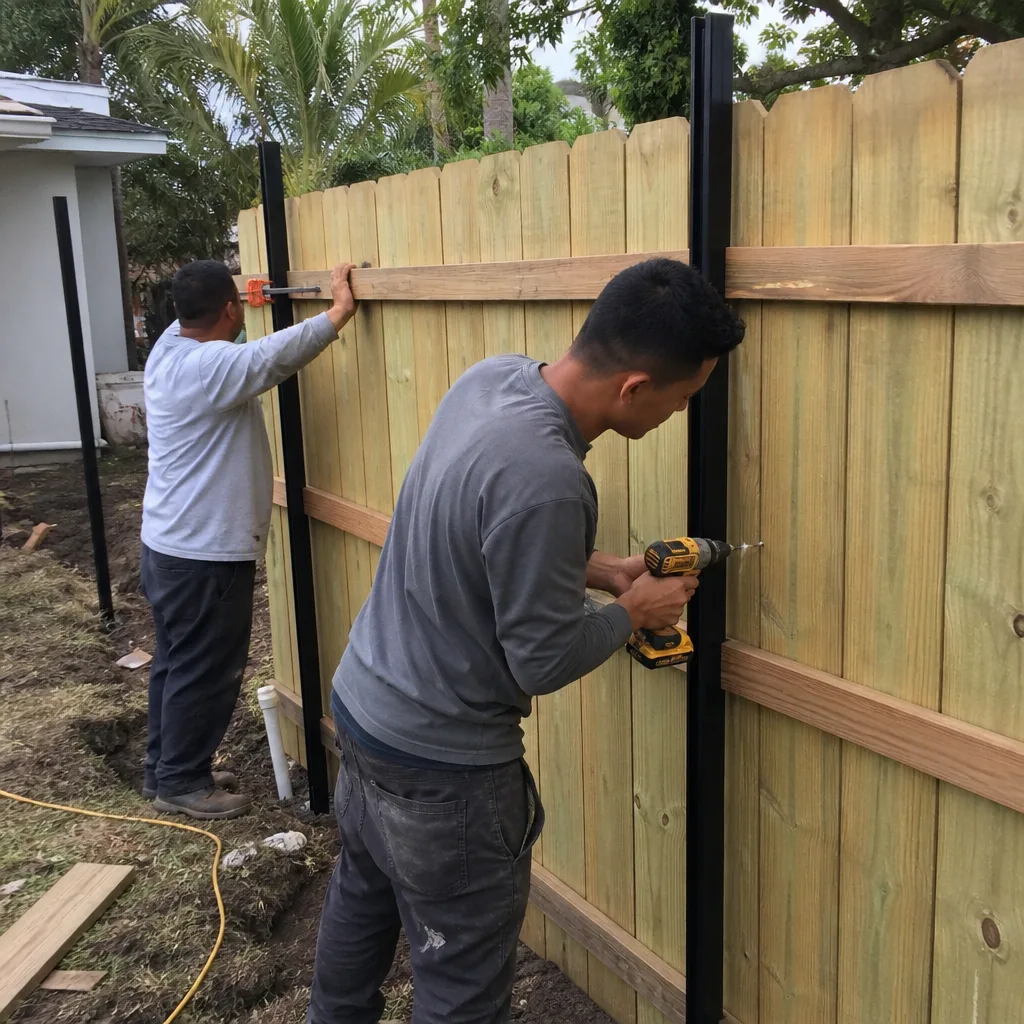
In Miami, a fence post should be buried a minimum of 24 to 36 inches, with most 6-foot privacy fences in coastal or high-wind zones needing at least 36 inches of embedment inside an 18-inch diameter concrete bell footing. The familiar 1/3 rule (bury one-third of the post length) is a starting point, not a finish line. Miami-Dade’s High Velocity Hurricane Zone wind-load requirements, sandy oolitic limestone soil, and a high seasonal water table all push footings deeper and wider than what a national fencing guide will tell you. If you want the depth and footing spec written into a fixed quote before anyone digs, call Groundwork Construction Co. of Miami at (833) 968-1198 for a free estimate.
Key Takeaways
- Short answer: 24-36 inches deep, with 36 inches as the practical floor for a 6-foot privacy fence in an HVHZ coastal exposure.
- The 1/3 rule was written for clay soils with stable water tables. Miami has neither.
- Sandy substrate and a shallow water table call for a wider, belled concrete footing, not just a deeper hole.
- Aluminum and steel posts in salt air need a corrosion barrier at the grade line or they rust out from the footing up.
Why the 1/3 Rule Fails in Miami’s Wind Design Standard
Miami-Dade County is the only place in the country with its own product-approval system. Every roof, window, shutter, and structural connection that goes into a Miami build has to carry a Miami-Dade Notice of Acceptance (NOA) number, not just a Florida or national approval. That same wind-first mindset is why the depth math for fence posts here is different from anywhere else.
A 6-foot post set 24 inches deep satisfies the 1/3 rule on paper. In practice, a Zone D (coastal) exposure under the High Velocity Hurricane Zone spec often calls for a 36-inch minimum embedment paired with an 18-inch diameter concrete bell footing to hit the required lateral resistance. The post isn’t just holding up its own fence. It’s anchoring a wind sail that takes a real design pressure during a June-to-November storm.
Wind exposure zones in Miami break down roughly like this:
- Zone D (coastal, open water exposure): Biscayne Bay frontage, Miami Beach, Key Biscayne. Highest design pressure. 36-inch minimum embedment with bell footings.
- Zone C (open terrain): Most of inland Miami-Dade. 30-36 inches for a 6-foot privacy fence, depending on post spacing and material.
- Zone B (suburban with obstructions): Denser interior neighborhoods with mature tree canopy and built-up blocks. 24-30 inches may be adequate, but only when the footing is designed for it.
Here’s the operator detail most guides skip: a quote that lists “concrete-set fence posts” without a specified depth, footing diameter, and zone is telling you the depth will get decided on-site when the crew hits whatever is under the grass. That is where fences fail two years later. Our footing design gets specified in writing before work starts. That’s part of the Fence Installation work we prepare for every job.
The Water Table Changes Depends on Where You Are
Depth isn’t the only number that matters. Where the water table sits changes how you pour. In low-lying areas of Hialeah, Miami Gardens, and sections near Biscayne Bay, the seasonal water table can rise to within 18 inches of grade during the wet season. That affects you two ways:
- Footing curing: A concrete bell poured into a hole that’s holding water won’t cure to full strength. It dilutes the mix, slows the set, and leaves you with a footing that looks fine and isn’t. Footing pours in these areas need to be scheduled around the water table, sometimes with a drain or a dewatering step built into the plan.
- Post longevity: Wood posts sitting in saturated soil for months of the year rot from the bottom up. Steel posts sitting in that same water rust from the inside out. Both are harder to inspect than a failing top rail.
Nobody drives around with a water table probe and a soil report in the truck, so the depth that works on higher ground in Kendall isn’t necessarily the depth that works two blocks off the bay. That’s why the site visit matters. If a contractor quotes a fence by phone without asking what neighborhood you’re in, ask them why.
Footing Design by Material: Wood vs. Aluminum vs. Steel
Miami’s salt-laden coastal air is a real problem for metal posts. Aluminum and steel posts need a corrosion barrier at the footing interface: a sleeve, a galvanized base plate, or both, depending on the post material. Without it, you get grade-line rust-out, where the post fails at exactly the point dirt meets air. That’s a footing design change, not just a depth change.
Wood posts in Miami also fight termite pressure, which is severe here year-round. We lean toward steel and aluminum for privacy fence structures with a wood or composite infill, and pre-treat any wood that touches grade.
| Fence Material | Typical Post Depth (Miami) | Footing Notes |
|---|---|---|
| Wood privacy, 6 ft, interior Zone B/C | 30-36 inches | Belled concrete footing, pressure-treated post at grade |
| Wood privacy, 6 ft, coastal Zone D | 36 inches minimum | 18-inch bell footing, termite-treated post |
| Aluminum 4-5 ft, decorative | 24-30 inches | Galvanized base plate at footing interface |
| Steel posts, ornamental | 30-36 inches | Corrosion sleeve, painted or galvanized post |
| Vinyl fence, 6 ft | 30-36 inches | Concrete-set post with structural insert |
Pricing scales with the footing spec. Vinyl fence installation in Miami runs $4,130-$10,620, and aluminum fence installation runs $4,720-$11,800. Deeper footings and coastal hardware sit at the top of those ranges. Upfront pricing matters here: the number you see is the number you pay, and the footing spec is part of that number, not a line item added later.
The Soil Reality: Depth Alone Doesn’t Solve Lateral Load
Miami sits on sandy oolitic limestone substrate. Unlike clay soils that grip a post and hold it, sandy ground has less lateral bearing capacity, which means a deeper hole alone won’t stop a post from leaning under wind load. The fix is a wider, belled concrete footing. The bell is what creates bearing surface against the sand. Digging deeper without belling wider is a common shortcut, and it’s the reason you see so many leaning fences after a summer of storms.
If you’re planning a fence alongside other exterior work, our home page covers the full scope of what Groundwork Construction Co. of Miami handles from foundation to finish line. That matters when you’re already tearing up part of the yard for pavers, a driveway, or an addition, because the fencing can be sequenced so the contractor isn’t re-digging a finished slab. If you’re mid-planning, our driveway and paver installation page is a good reference for how exterior work coordinates with fence lines. Call (833) 968-1198 to talk through how the timeline fits together.
FAQs
A 6-foot fence post in Miami should be buried at least 30 inches inland, 36 inches on the coast and in Zone D wind exposure. The 1/3 rule gets you to 24 inches, which passes the rule but often fails the HVHZ wind-load spec for lateral resistance. Add a bell footing to match the depth. Call (833) 968-1198 for a same-day or next-day site check.
Yes, concrete is standard for Miami fence posts because sandy oolitic limestone does not grip a post the way clay does. The bell footing, not just the depth, is what holds the fence against wind. Packing sand around a post without concrete is a shortcut that leans within a season or two. Call (833) 968-1198 for a quote with the footing spec in writing.
The water table doesn’t usually change the required depth, but it changes how the footing gets poured and cured. If the water table sits within 18 inches of grade in low-lying parts of Hialeah, Miami Gardens, or near Biscayne Bay, the footing schedule and any dewatering step need to be planned before the pour. Call (833) 968-1198 and tell us your neighborhood so we can flag it.
Fence installation in Miami typically runs $4,130-$10,620 for vinyl and $4,720-$11,800 for aluminum, with cost driven by fence height, footing design, and coastal wind-zone requirements. Installation is covered by the 730-Day Done Right Promise, so if a footing or post isn’t right, we make it right. Call (833) 968-1198 for a free estimate and to lock in the $1,000 off projects over $10,000 offer.
If you’d rather have it looked at, Groundwork Construction Co. of Miami offers a no-pressure assessment in Miami - call (833) 968-1198. Our technicians have up to 12 years of experience on residential fence work, all with background checks and uniform presentation. Most site evaluations are done in a single visit, and every quote comes with the footing design in writing before work starts.
Written by the team at Groundwork Construction Co. of Miami, serving Miami, FL.