
 Kitchen remodeling
 Bathroom remodeling
 Home additions & ADU
 Roofing
 Windows & doors
 Driveway & pavers
 Fence
Free written scope consultation - allowances, timeline, and change-order rules on paper before a single trade is scheduled
Styles & brands we work with
- Kitchen remodeling
- Bathroom remodeling
- Home additions & ADU
- Roofing
- Windows & doors
- Driveway & pavers
- Fence
See the difference
 Before
 After
 Before
 After
 Before
 After
Custom vs Stock Kitchen Cabinets in Miami: The Honest Answer for CBS Homes and High-Rise Kitchens
For most Miami kitchen renovations, semi-custom cabinets are the right call. Choose full custom only if your kitchen has floor-to-ceiling runs in 10-foot-plus ceiling spaces, integrated appliance panels, or hardware that no catalog carries – the Brickell and Coconut Grove tier. Choose stock only when the room is genuinely plumb, square, and sized in 3-inch increments. In pre-1970 CBS homes, that’s rare. The price gap between stock and semi-custom usually narrows once you pay for filler strips, scribe molding, and shimming, which is why we steer so many homeowners toward the middle path. Call (833) 968-1198 for a free project estimate and design consult, and we’ll tell you which tier your kitchen actually needs.
Why Miami’s Housing Stock Breaks the Stock Cabinet Playbook
Stock cabinets are manufactured to a fixed grid. Boxes come in 3-inch width increments, depths are standardized, and the whole system assumes walls that are plumb and floors that are level. Miami’s older concrete-block and stucco homes are almost never any of those things. Those CBS walls were poured and finished by hand decades ago, and even a wall that reads straight to the eye can be out of plumb by a half inch over an eight-foot run. Floors in these homes settle and slope. Ceiling heights wander off the standard eight feet, especially in 1920s Mediterranean Revival and Miami Modern properties where openings and soffits were built to a custom rhythm nobody sells a catalog box for.
What to Look For: The Measurement Reality
When a stock box meets an out-of-square corner, somebody has to fill the gap. That’s a filler strip – a flat piece of matching material that bridges the space between the cabinet edge and the wall. In a kitchen with one corner out of square, one filler is fine. In a kitchen with several non-standard wall runs and corners, you end up with a row of fillers, each one a visible seam and a strip of dead space. Add scribe molding to hide the wavy wall-to-cabinet line and shims under every box to level it, and the labor climbs. The cabinet cost stays low, but the install cost goes up and the finished result still looks pieced together.
Here’s what we tell homeowners to check before deciding:
- Wall runs: Count how many separate stretches of wall the cabinets will sit on. More runs mean more chances for out-of-square corners and more filler strips.
- Corner configurations: A kitchen with three or four corners inside a tight footprint fights stock dimensions hardest. Dead corners are where stock loses the design battle.
- Ceiling height: Measure at the wall, at the center of the room, and at the opposite wall. If those numbers don’t match, stock uppers will need trim to close the gap to the ceiling.
- Plumb check: A four-foot level against each wall run tells you what the installer will be fighting.
The more items on that list that come back crooked or non-standard, the less sense stock makes. That’s the measurement reality we walk into on nearly every kitchen remodel in these older neighborhoods.
The Semi-Custom Middle Path That Fits Most Miami Budgets
KraftMaid semi-custom is the answer for the majority of Miami renovation budgets we quote. The line offers sizing in 1/8-inch increments and hundreds of door styles, so a semi-custom box can be built to fit the actual wall instead of forcing the wall to fit a grid. That closes roughly 80% of the gap between stock and full custom, and it lands at 40-60% of the full custom price. You get a cabinet that fits the room, in the door style you want, without paying for a one-off cabinet shop build.
For most homeowners, that’s the sweet spot. The cabinets fit properly, the installer wastes less time forcing filler strips into gaps, and the finished kitchen looks like it was designed for the space rather than assembled in it. This is why we put KraftMaid on the short list for semi-custom kitchens, alongside Wellborn when a homeowner wants a different door and finish palette.
When Full Custom Earns Its Price
There’s a specific Miami buyer where full custom is the only honest recommendation. If you’re renovating a high-floor Brickell or Coconut Grove kitchen with 10-foot-plus ceilings and you want floor-to-ceiling cabinet runs that read as a single unbroken wall, a semicustom catalog won’t get you there. Full custom also wins when the design calls for integrated appliance panels, specialized hardware, or a depth and configuration no semi-custom line offers. In those kitchens, the premium buys you a result the catalog can’t produce.
Here’s how the three tiers compare on the things that decide a Miami kitchen:
| Factor | Stock | Semi-Custom (KraftMaid / Wellborn) | Full Custom |
|---|---|---|---|
| Sizing increments | 3 inches | 1/8 inch | Any dimension |
| Fit in out-of-square CBS walls | Filler strips, dead corners | Built to fit, minimal fillers | Built to fit, zero compromise |
| Door styles | Limited | Hundreds | Unlimited |
| Typical lead time | 1-2 weeks | 4-8 weeks | 10-16 weeks |
| Relative cost | Lowest | 40-60% of full custom | Highest |
| Best fit | Plumb, square, standard rooms | Most Miami renovations | Brickell / Coconut Grove high-end builds |
How Lead Time Reshapes Your Miami Remodel Timeline
Cabinets are the long pole in most kitchen timelines, and in Miami the calendar is already working against you. Miami-Dade permit review routinely adds 3-6 weeks before a wrench turns. Layer a full custom cabinet order on top at 10-16 weeks from order to delivery, and you can be looking at a kitchen that’s torn apart for the better part of a season. Semi-custom at 4-8 weeks fits the renovation rhythm far better. Stock at 1-2 weeks sounds fast until you pay for the filler strips and shimming that the out-of-square room demands.
There’s a second local reason lead time matters. Exterior work in Miami is squeezed into the window before and after hurricane season, and a kitchen remodel that drags forces every other project around it to wait. Choosing a cabinet tier that delivers when the installer is ready keeps the whole job moving.
Why Installation Workmanship Is What the Guarantee Actually Covers
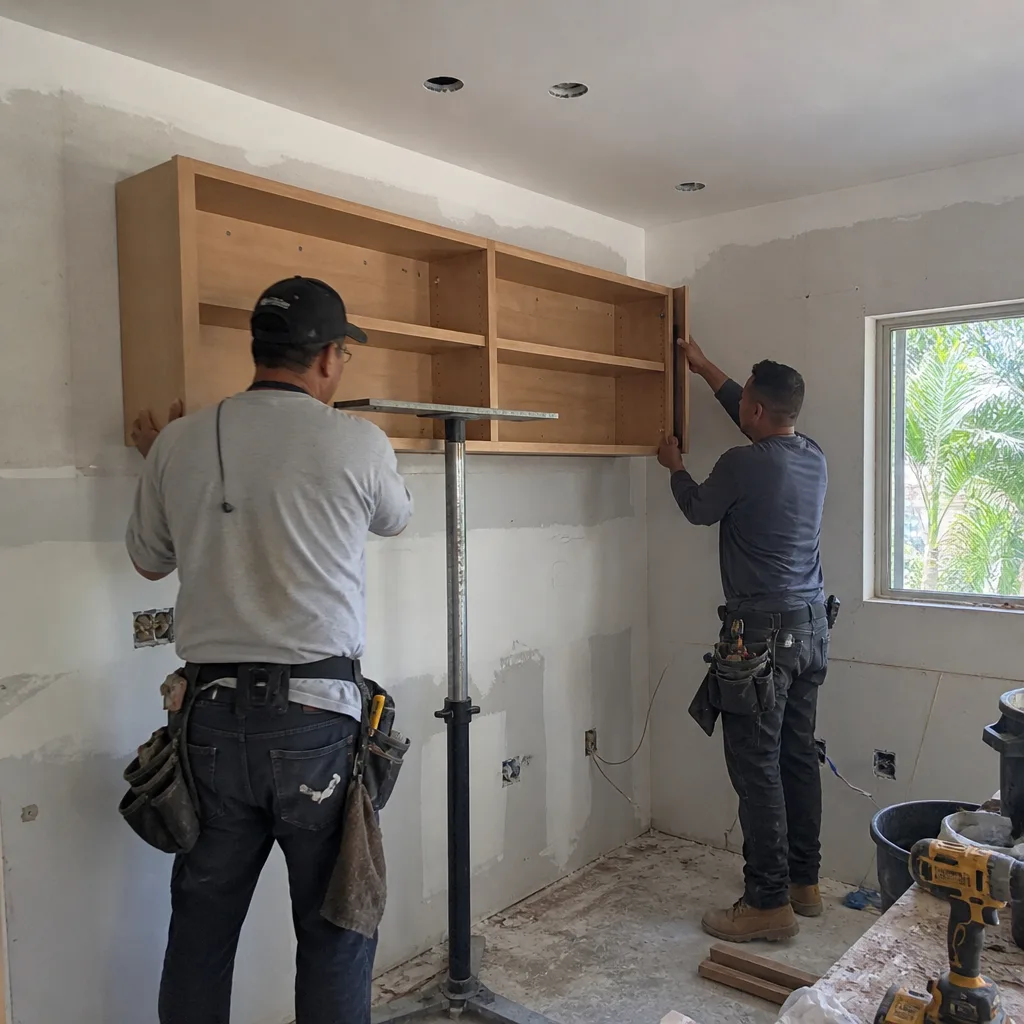
The catalog the doors came from matters less than how the boxes go into the wall. In CBS construction, cabinets must be secured with proper masonry anchors, not driven in with drywall screws that pull free under load. Every box needs leveling, every run needs shimming, and every seam needs to close tight. That’s the work our background-checked, uniformed technicians handle on every project, and it’s the workmanship our 730-Day Done Right Promise stands behind for a full two years. If the installer’s work fails, we make it right – regardless of whether the doors are stock, semi-custom, or full custom. A cabinet line is only as good as the crew that hangs it.
Pair that installation with the upfront pricing we quote, and you know the number before the first box arrives. The number you see is the number you pay. We also carry 0% financing for 18 months and $1,000 off projects over $10,000, so a semi-custom kitchen that runs into the low thousands of dollars for the cabinet line fits a real budget instead of a wish list. For homeowners planning the full scope, our Kitchen Remodeling in Miami page lays out the whole project, and you can see how cabinets fit into the broader cost picture. Have a look at our home page for the full range of what we build.
FAQs
A full Miami kitchen remodel runs $16,520-$53,100, and cabinet installation alone runs $4,720-$15,340. Stock sits at the low end of the cabinet line, semi-custom in the middle, and full custom at the top. The gap between stock and semi-custom narrows once you factor in the filler strips and shimming an out-of-square CBS kitchen demands. Call (833) 968-1198 for an exact quote – estimates are free.
Replacing is usually the right call when the boxes themselves are failing or the layout no longer works, and repairing only makes sense when the cabinet boxes are solid and just the doors and hardware are tired. In pre-1970 CBS homes, aging boxes often don’t justify the money a repair costs. Call (833) 968-1198 and we’ll walk you through which way your kitchen leans.
Installation timing depends on the cabinet tier you choose, not the install itself. Stock arrives in 1-2 weeks, semi-custom in 4-8, and full custom in 10-16 – and Miami-Dade permit review adds 3-6 weeks on top. We’ll map your exact timeline during the free consult. Call (833) 968-1198 to get that conversation started.
Your cabinet tier doesn’t change hurricane requirements, but the broader remodel does. Miami-Dade sits in the High Velocity Hurricane Zone, and every exterior product – windows, doors, roofing – must carry a Miami-Dade Notice of Acceptance, not just a Florida or national approval. If your kitchen remodel touches windows or exterior walls, those items carry the NOA requirement. Cabinets themselves are interior and don’t.
If you’d rather have it looked at, Groundwork Construction Co. of Miami offers a no-pressure assessment in Miami – call (833) 968-1198 for a free estimate, and we’ll measure the walls, check the corners, and tell you plainly which cabinet tier your kitchen needs before you spend a dollar on an order.
Written by the team at Groundwork Construction Co. of Miami, serving Miami, FL.